Tuesday, March 8, 2016

2016 Honda Civic: Hidden Easter Eggs Revealed

by Paulo Acoba of www.artofgears.com

New owners of the 2016 Honda Civic Sedan got a bit of a surprise when they found these easter eggs hidden in their car.

Oftentimes car manufacturers will slip in a couple of easter eggs (unexpected or unofficial features as a bonus) and it looks like Honda and their new 2016 Civic is no exception. According to Honda Pro Jason and confirmed by the fine people over at CivicX,  the 2016 Honda Civic has at least one Easter Egg that comes standard on all 2016 Honda Civic Sedans. Within the center console and underneath the removable mat, there is a special imposed image of a couple of milestones in Honda’s history displayed. Check out the video of Honda Pro Jason revealing one of the images below.

To our knowledge, there are four total image sets put in at random. We’ve included all the Easter Eggs below as well as a bit of information on each.

This first Easter Egg features MotoGP rider Marc Marquez in the Honda RC213V race bike. Next to the bike is Honda’s S600 Racecar with this particular example residing in Honda’s Collection Museum. The F1 Car is their British American Racing Honda probably from 2005 with Jenson Button behind the wheel. And the Honda Jet makes an appearance in the top right corner.
Photo Credit: CivicX
For this splash guard, the Honda Jet makes a return on the upper left-hand side. The center image is Japan’s first winning car in Formula 1 that happens to also be a Honda, the RA272. And the other car in the middle right is a 1920’s era Curtiss Racer. According to Honda;

"When Honda was an apprentice at Art Shokai, he assisted the company’s owners, the Sakakibara brothers, in building a Curtiss racer. He accompanied them as their riding mechanic at races, and they won the fifth Japan Motor Car Championship on November 23, 1924."
2016.3.6 3
On this splash mat, we see the Honda RC166 in the top left corner. During the 1966 World Championships for MotoGP in the 250cc classes, Honda captured the overall win by snagging 10 out of 10 races for two consecutive years. The Formula 1 car is the McLaren MP4/5 piloted by the legendary Ayrton Senna. And the Honda Jet makes a return in the top right corner.
2016.3.6 4
Finally on this splash mat,  we see Honda’s ASIMO robot with a long robotic history stretching back to the 1980’s and dubbed the unofficial spokesperson for Honda. The Grand Prix rider is none other than Freddie Spencer on a Honda NS500 probably taken from one of his races in 1983 where he captured first place overall at just 21-years old. Again, the Honda Jet makes an appearance.
2016.3.6 5
Car manufacturers don’t have to add easter eggs, but they do as a nod to their loyal customers and to add a personal touch. You can read into these particular choices on these removable splash plates as much as you want but honestly they’re just a bit of fun.

The fact that Honda included their jet all four times points to them looking towards a bright future with an emphasis on their non-automotive achievements. The inclusion of all their best race cars cements Honda as a car company with Racing DNA a crucial part of their identity. If there’s no racing, there’s no Honda. And Honda ASIMO highlights their endeavours outside of transportation, making them a well-rounded company.

With the Honda Civic Coupe, Hatchback, Si and Type R yet to hit our showroom floors, there’s no indication if there are more easter eggs out there, but they’ll probably have a few of their own.
Honda Pro Jason did say that the all-new Honda Ridgeline has a couple of hidden easter eggs we have yet to find so we’re all ears to what those will be when people find them out.

Source;
https://artofgears.com/2016/03/07/2016-honda-civic-hidden-easter-eggs-revealed/

Monday, March 7, 2016

Avoid Tesla Because Hydrogen Is The New Electric

Summary

EV business model may not overcome competitive FCV threat.

Major automotive manufacturers are adopting and advancing FCV technology.

Avoid Tesla stock due to lack of product diversity and competitive forces.

by Joseph Ghanem of www.seekingalpha.com
FCVs (Fuel Cell Vehicles) started out over a decade ago as technology that was in its infancy stage, and clearly not ready for prime time. A decade later, and it appears the time has come for fuel cell vehicles to reclaim the mantle as the most energy efficient, practical and realistic choice for the zero-emission car-buying consumer.

Arguably, the most challenging issue facing Tesla (NASDAQ:TSLA) is the further development and prevalence of FCVs in the global automotive industry. Fuel cell vehicles are gaining traction. And with major auto makers, such as Toyota (NYSE:TM), Hyundai and Honda (NYSE:HMC) starting to invest, it is only a matter of time before the technology becomes mainstream. The existential threat that could derail Tesla is not just smoke and water. The eventual shift from EVs (Electric Vehicles) to hydrogen-powered FCVs is real, and Tesla may be in serious trouble.

Fuel Cells
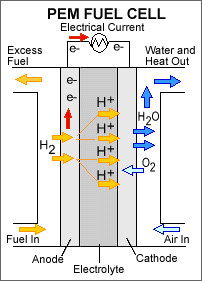
There are many different types of fuel cells available. For vehicle purposes, the most common is the Polymer Electrolyte Membrane (PEM) fuel cell.
Source: Office of Energy Efficiency & Renewable Energy
The process works by taking fuel (hydrogen) and oxygen molecules into the fuel cell. Hydrogen is channeled to the anode, and oxygen to the cathode. They are split through the use of a catalyst, which in most cases is platinum. The hydrogen splits off into positive hydrogen ions (protons), and negatively charged electrons. The PEM cannot let the electrons into the membrane or else it would short circuit the fuel cell. Once the hydrogen is split, the positive ions flow through the membrane to the cathode. The electrons that were broken off from the hydrogen also travel along an external circuit to the cathode, which in turn creates an electrical current. At the cathode, the electrons and the positive Hydrogen ions meet with oxygen to form water (H20), which exits the fuel cell.

There are a few trade-offs with this system. The first is the use of platinum as a catalyst for the breakdown of the molecules. Platinum is an expensive material, and without a replacement catalyst or a reduction in price fuel cells will always be expensive to produce. Secondly, separating oxygen significantly reduces electricity that can be generated due to the difficult nature of splitting oxygen molecules, which makes the process of producing electricity from the circuit less efficient.

Fuel cells are also extremely sensitive to any permutation in the system. Electrons need to flow through the proper channels; they cannot leak into the membrane where the positive hydrogen ions pass through to meet oxygen. Furthermore, hydrogen is volatile to store. In order to safely house hydrogen, fuel tanks in cars need to maintain pressure in a PSI range of 5000-10,000.

Infrastructure
While fuel cell technology has advanced in recent years, the infrastructure for hydrogen refueling stations is currently not where it needs to be for fuel cell vehicles to become mass-market. This issue seems to be the Achilles heel of fuel cell vehicles, as a lack of refueling stations would lead to marginal sales volume. However, major investment into hydrogen fueling networks have begun in California and the Northeastern states. With time and capital, the network of hydrogen refueling stations will continue to grow as fuel cells gain efficiency and popularity.

California has been the leader in support of zero-emission vehicles; offering rebates in the range of $3000-$5000. In 2014, the California Energy Commission announced it would invest $46.6 million to speed the development of hydrogen fueling stations, with the hope of reaching the goal of 100 refueling stations that would allow for the commercialization of FCVs in California. The state is planning to double the number of hydrogen refueling stations that are currently available this year. According to the California Fuel Cell Partnership, there are twelve available hydrogen refueling stations in California. The map also shows about another 30 retail locations that are in development. In an interview, Hyundai Motor America CEO David Zuchowski anticipates 40 refueling stations to be open before the year's end of 2016.

Though California is the testing ground for new technology, Toyota sees promise in the Northeast. Toyota is helping to develop and supply, with the help of France's Air Liquide, twelve hydrogen refueling stations in Connecticut, Massachusetts, New Jersey, New York, and Rhode Island. The plan for Northeastern hydrogen refueling stations is part of a broader coalition called The Northeast Electrochemical Energy Storage Cluster (NEESC). NEESC has outlined hydrogen and fuel cell development plans for eight states located in the Northeast, with the goal to "increase awareness and facilitate the deployment of hydrogen and fuel cell technology." Further advancing infrastructure, eight Northeastern states have signed a memorandum of understanding that would require manufacturers to sell 3.3 million zero emission vehicles in the geographic area. This figure includes both FCVs and EVs. The NEESC has a goal of 110 hydrogen refueling stations by the end of 2018 in the Northeast.

Another alternative is the installation of hydrogen refueling stations at already established gasoline stations. The move would make sense, as a shift to EVs in the United States and in Europe would affect the revenues of oil companies. However, providing hydrogen alongside traditional gasoline at these stations would create the opportunity for an additional revenue stream, while maintaining the core business. Shell has been adopting hydrogen fueling stations to select locations in California, with plans to add more in the future.
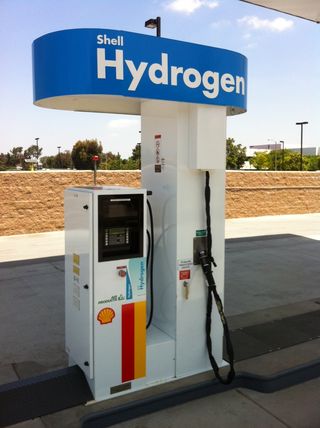
Through the use of existing stations, building the infrastructure needed for mass-market hydrogen consumption is the most realistic. The problems that are associated with hydrogen, such as transportation and storage, would be alleviated by direct lines to the pump at the gas station. As well, many states derive tax revenue for the building and fixing of roads, bridges, and highways from gasoline taxes. With a gradual shift from gasoline to hydrogen, oil companies can maintain relevance, while the state can still collect taxes on the fuel coming out of the pump.

The current amount of capital needed to add-on or build a hydrogen refueling station totals $1 million, yet, the actual cost comes closer to $1.5 million, according to Hyundai Motor America CEO David Zuchowski. While electric charging stations typically require an average of $250,000 to install, hydrogen refueling stations require more intensive construction and maintenance. Despite needing the additional capital to fund the infrastructure, the business perspective paints a clearer picture.

A typical EV takes around 8-14 hours for level 1 charge (120 volt AC) or 4-9 hours for a level 2 charge (240 volt AC). Tesla's supercharger only recharges around 50% of the battery after 30 minutes. The supercharger is not a public charging station or high voltage outlet, and requires a specially built station to output 120 kW of DC power. Consequently, batteries are not like gasoline or fuel cell vehicles in the way that the car must reduce the current above a certain percentage to top off the battery. With that in mind, it would take Tesla's supercharger nearly 75 minutes to fully charge a 90 kWh Model S.

From the hydrogen perspective, a FCV takes no more than 3-5 minutes to fill up. Given the early stages of hydrogen refueling station technology, that time estimate would likely drop with advancements. To a business, the number of electric charging stations required to satisfy public demand would be at least four to five times the amount comparable to hydrogen stations. That also assumes that EVs can be charged 50% in a decent amount of time, much like the Model S. From that point of view, electric charging stations do not seem to make much sense for any business to own and operate, as home recharging would seem like the only viable solution to consumers.

Models
Development of FCVs have been underway for years. Hyundai released their first FCEV (Fuel Cell Electric Vehicle) in 2001 with the Hyundai Sanata Fe FCEV. Honda's first delivered model of fuel cell cars was the 2002 FCX. Over the past year, there have been numerous car companies expanding their lineup to include new FCVs. As production costs associated with fuel cells declines, more auto manufacturers will begin creating models that can leverage the new technology. A list of recent models produced by different companies is as follows:
  • Audi - A7 H-Tron Quattro
  • Honda - FCX Clarity
  • Hyundai - Tucson Fuel Cell
  • Mercedes-Benz B-Class F-Cell
  • Toyota - Mirai
Focusing on the Toyota Mirai which was recently released, how does it compare against a similar style EV? The Volkswagen (OTCPK:VLKAY) E-Golf is a sedan EV that is roughly the same in dimensions and weight as the Mirai, making for a good study in the differences between FCVs and EVs. The Volkswagen E-Golf starts at a base MSRP of $29,800, with a 24 kWh battery and an EPA range of 83 miles. The base model does not come equipped with a 7.2 kW onboard charger, and instead has a level 2 charger rated at 3.6 kW. Charging to full takes roughly four hours for the base model. If the 7.2 kW onboard charger is added, the time is reduced to around two hours. The motor outputs 115-hp and 199 lb-ft of torque.

The Toyota Mirai, meaning "future" in Japanese, starts close to $58,500. The Mirai also qualifies for federal tax and state tax credits like EVs do. Toyota offers three years of complimentary hydrogen fuel to all new buyers, which can be seen as a $10,000 value if it is assumed hydrogen fuel prices maintain parity with gasoline. Refueling takes only about 5 minutes, and on a full tank of hydrogen the car gets an estimated 312 mile range. The electric motor powering the Mirari outputs 151-hp and 247 lb-ft of torque.

Even though this is one comparison, the differences are evident. Barring the price difference, the Toyota Mirai beats out the Volkswagen E-Golf in range, fill time, and power. The only major distinguishing factor is the price. Electric vehicles have been in production for a better part of the last decade, and it should come as no surprise that they will be cheaper than new fuel cell powered vehicles. Once cheaper materials and more efficient fuel cell stacks are created, the price of FCVs will come down to match EVs, making FCVs more economically beneficial.

Consumer Perspective
The battle over which zero-emission vehicle is more efficient is meaningless if the consumer perspective is discounted. Consumers have grown accustom to using gas stations as the means to fill their car up. The difference between charging an EV, which might take up to 14 hours depending on the voltage being used, or five minutes that it takes to refill a FCV cannot be understated. In today's fast-paced environment, the need to charge a car every day or two can simply become an inconvenience.

The negatives of EVs do not stop from a time standpoint, but also from an efficiency standpoint. On average, EVs have their range reduced by 57% in cold weather (20 degrees Fahrenheit), and 33% in extreme heat (95 degrees Fahrenheit). Combined with the fact that EVs have less overall range than comparable FCVs, the benefits of a FCV become clear. Group Vice President and General Manager of the Toyota Division, summed up the benefits of FCVs over EVs best in an interview at the 2014 Chicago Auto Show:
It really provides all the benefits of a plug-in EV without the range anxiety and without the time it takes to recharge it.
Takeaway
What the future holds for the next generation of zero emission vehicles is certainly up for debate. Right now, major automotive brands are gearing up, picking a side and fighting for the zero emission vehicle of their choice. Toyota, Hyundai, Honda and a few others have already committed to creating fuel cell vehicles going forward. Stalwart brands, such as Tesla, Nissan (OTCPK:NSANY), and GM (NYSE:GM) have remained steadfast in their commitment to further developing EVs.

The difference comes down to practicality and convenience. In the end, the consumer is what drives the market for any new technology. I fully anticipate that once the infrastructure for hydrogen refueling is sufficient FCVs will catch on with car makers and consumers. The advantages FCVs offer over EVs are numerable, and with each passing day fuel cell technology improves.

To a company like Tesla whose core brand is built around all-electric vehicles, this paradigm shift presents a problem. Every other car company can adapt to changing market conditions by offering products that consumers demand. However, Tesla limits themselves by only offering EVs. Couple the lack of car options with the poor financial health of the company, Tesla seems to be in dire straits. Due to the reasons outlined above, I would recommend staying clear of the stock.

Disclosure: I/we have no positions in any stocks mentioned, and no plans to initiate any positions within the next 72 hours.
 
I wrote this article myself, and it expresses my own opinions. I am not receiving compensation for it (other than from Seeking Alpha). I have no business relationship with any company whose stock is mentioned in this article.

Source;
http://seekingalpha.com/article/3956209-avoid-tesla-hydrogen-new-electric

Friday, March 4, 2016

Honda expands turbo power to 2017 Honda CR-V


by Parks McCants

Thursday, March 3, 2016

15yo Indian boy battling aging disorder buddies up with Honda's Asimo

Nihal Bitla takes a selfie with Honda's humanoid robot Asimo in suburban New Delhi on Feb. 2. (Photo by Shinya Sawai)
by HIROSHI KOTANI

NEW DELHI   Nihal Bitla, a 15-year-old Indian boy with a genetic aging disorder, had three dreams: to take a ride in a Lamborghini, to meet Honda Motor's robot Asimo, and to go to Disneyland. Last year, he got his chance to check out the Italian supercar. And in early February, he found himself face to face with his favorite humanoid.

     The encounter happened just outside New Delhi at the venue for Auto Expo 2016 on Feb. 2. It was the day before India's largest motor show opened. Nihal's family had traveled from their home in a Mumbai suburb, more than 1,000km away.

     The big moment came at 4 p.m. With Nihal watching from a front-row seat, Asimo stepped on stage. The robot walked slowly, waving its left hand, to the center. Then it bowed to the young man, putting its palms together in front of its chest to perform the namaskar gesture. Nihal put his small, frail hands together and returned the greeting. With that, the show began.
Nihal Bitla, one of about 130 recognized sufferers of progeria worldwide, plays with a robotic dog. (Photo by Subhash Sharma)
ONE IN 18 MILLION   Nihal is the eldest son of Srinivas Bitla, 39, and Devi Bitla, 33. His father, Srinivas, runs a cellphone repair shop. The couple has three children.

     Srinivas and Nihal share a birthday -- Jan. 20. Srinivas said he was "very excited" when his son was born and, wishing him a lifetime of happiness, named him Nihal, which means "joyous and successful."

     Nihal weighed 3kg at birth. Before long, his body started to change. First, small spots and specks appeared on his skin. When he grew enough to sit, his head expanded and his hair began to fall out. His father took him to hospital after hospital, but no doctor was able to diagnose the problem. Finally, five years ago, they found Parag M. Tamhankar, a doctor at the National Institute for Research in Reproductive Health in Mumbai.

      Tamhankar told them that Nihal was born with progeria, or Hutchinson-Gilford progeria syndrome. Sufferers experience rapid aging -- seven to eight times faster than normal -- and live only to 14 on average. There are no known cures. 

     This congenital genetic disorder is said to occur at a rate of one in about 18 million people, regardless of race or gender. As of Jan. 1, the Progeria Research Foundation in the U.S. state of Massachusetts recognized 134 sufferers worldwide, including people with similar disorders.
 
     Nihal shows typical symptoms: He has deep wrinkles on his face and hands. He has no hair and weighs only 14kg. With his small, lean frame, he faces a high risk of heart attack. His outlook, however, is positive. "I'm happy as I am," he said. "I don't want to be like an ordinary child."

     Like many 15-year-olds, Nihal is shy. But he has a passion for robotics. At home, he has a small remote-controlled robot that he has disassembled and reassembled more than 15 times. He loves to watch YouTube videos of robots and other mechanical devices. When he talks about the history of Asimo, his eyes brighten. 

 Katsushi Inoue, president of Honda Cars India, heard about Nihal's dream to meet Asimo last September, when the company was beginning to plan for Auto Expo. Honda decided to invite Nihal and his family to a special stage presentation. Inoue kept a message for Nihal in mind as he prepared the show: "Stay courageous. Asimo will come and cheer you up."

FAST FRIENDS   During the performance, Asimo pulled off its signature tricks with ease. It stood on one leg, jogged and kicked a soccer ball. Then the robot danced to "India Waale," an upbeat song from a Bollywood movie. Nihal clapped along.

     The best part, for Nihal, may have come after Asimo finished strutting its stuff. He went up on stage and approached the robot. His father handed him a smartphone so that he could snap a selfie with his high-tech buddy.

     "I always liked Asimo," Nihal said. "He was my most favorite, and he will remain my favorite. We became friends on stage."

     Asked whether he would buy an Asimo if Honda started selling the robot, he was quick to say "yes." Told the robot might be very expensive, he replied with a smile, "I can save money to buy it."
     Nihal asked to meet the Honda team that works with Asimo. He peppered the engineers, who had come over from Tokyo, with questions like: "How long does it take to program Asimo?" "How much does Asimo move on a single charge of its battery?" "How many sensors are used in Asimo?"

RAISING AWARENESS   India, with its vast population, may have more than 60 people with progeria, but the U.S. research foundation is aware of only four. Nihal is leading a campaign to raise awareness, find unrecognized patients and introduce them to treatment options.

     Trials have shown that Lonafarnib, a cancer drug, is effective in reducing progeria symptoms to a certain extent, and Nihal takes the medication twice a day. Still, nobody can tell how long he will be able to carry on. "I am ready to accept everything," his father said.

     Dream No. 3, going to Disneyland, is still on the to-do list. Nihal's parents are hoping to arrange a trip to California.

Source;

Honda Amaze Facelift Launched in India; Priced From 5.29 Lakh

This car is not for North America, think of a Honda Fit as a sedan....
Keeping up with the growing competition, Honda Cars India has launched the new Amaze facelift in the country with prices starting at 5.29 lakh (ex-showroom, Delhi). The popular selling compact sedan gets a host of cosmetic and feature upgrades including a refreshed front and rear fascia and new colour options. The cabin too receives an upgrade thus adding to the premium feel of the car. In addition, Honda has also increased the prices for the Amaze facelift range, in-line with the new taxation policies announced under the Union budget.

To begin with, the Honda Amaze facelift gets a revised front fascia sporting a wider single chrome grille, similar to the Mobilio, while the headlamp cluster gets smoked treatment for a more upmarket appeal. The bumper too has been tweaked and gets a three-part layout with larger air-intakes, intended to lend a fresh look to the compact sedan. The side profile retains its  styling, whereas the rear gets revised tail lamps and boot lid.

The Honda Amaze facelift's cabin gets extensive upgrades with a completely new centre console with brushed aluminium inserts and piano black finish and looks very premium. The instrument cluster has been tweaked as well. Honda has retained the dual tone beige and black colour interior scheme, three-spoke steering wheel and gear shift knob on the facelifted version. The air-con vents are squared now and look sharp, compared to the round ones seen on the outgoing model.

Things remain the same under the hood with the Honda Amaze facelift powered by the same 1.2-litre i-VTEC petrol engine tuned to produce 87bhp and a peak torque of 109Nm, while diesel power comes from the 1.5-litre i-DTEC motor tuned for 99bhp of power and peak torque of 200Nm. The fuel efficiency figure for the petrol variant stands at 17.8 km/l (MT) and 18.1 km/l (CVT), while the diesel returns a fuel economy of 25.8 km/l. Transmission options include the same 5-speed manual and a  first in segment CVT unit.

The people at Honda say that the CVT has been tuned to provide seamless power without compromising on fuel efficiency. Honda however, claims that the new Amaze has better NVH levels while improvements have been made to the ride quality as well. As far as safety features are concerned, the Amaze will come with dual airbags as an option from the base variant. However, Honda mentions that Dual airbags will be introduced as a standard feature in all of Honda's models which will be launched from FY 16-17.

The Amaze managed to change Honda's fortunes in India when it first went on sale in 2013 being the youngest sedan from the Japanese manufacturer and the first model from the company to get a diesel heart. Over the years, manufacturers have introduced better and more effective products in the segment. With the facelift, the Amaze continues to stay relevant in the highly competitive segment. Bookings for the new Amaze facelift has commenced at dealerships across the country.
Key Features At A Glance
1. ABS with EBD
2. Digital AC Controls
3. Dual Tone Dashboard
4. Steering Mounted Audio Controls
5. Audio System with BlueTooth and HFT
6. Keyless Entry
7. Driver Seat Adjuster
8. 3D Speedometer with Multi Information Display 
9. Power Foldable ORVMs
10. CVT Transmission
 
Honda Amaze Variant-Wise Pricing (ex-showroom, New Delhi)
Petrol
E MT 5,29,900
S MT 5,95,400
SX MT 6,80,500
VX MT 7,19,900
S CVT 7,19,900
VX CVT 8,19,900
Diesel
E MT 6,41,900
S MT 7,29,900
SX MT 7,82,000
VX MT 8,19,900

Source;
http://auto.ndtv.com/news/honda-amaze-facelift-launched-in-india-priced-from-rs-5-29-lakh-1283484

Tuesday, March 1, 2016

2016 Honda Civic Hatchback Prototype - Studio and Promotional Videos


The next-generation Civic hatchback makes its global debut in prototype form at the 2016 Geneva Motor Show. The design of the prototype heralds a significant step-change from previous versions of Honda’s core European model, focusing on provocative design and rewarding driving dynamics.

The all-new Civic hatchback will be 30 mm wider, 20 mm lower and 130 mm longer than the current generation. New larger and wider wheels and tyres give a feeling of an assured stance, while the long wheelbase, short overhangs and sleek cabin area further add to the dynamic feel of the exterior.


Toyota C-HR crossover leaked ahead of Geneva

C-HR....really?!?....and those tail lights look pretty close to the 2016 Civic....all in all though, really nice looking vehicle.
The Toyota C-HR has leaked to the web ahead of its debut at the Geneva Motor Show next week.

Previewed by the C-HR concept, the production model is a stylish crossover which features an aggressive front fascia with a slender grille and distinctive headlights.  Moving further back, we can see bulging wheel aches, plastic body cladding, and a rakish windscreen.  The crossover also has a gently sloping roof, an angular beltline, and small rear windows.  Other highlights include hidden rear door handles, a 'floating' rear spoiler, and boomerang-shaped taillights.

Toyota has been tight-lipped about specifications but the model will ride on the same TNGA platform that underpins the Prius.  A variety of different engines will be available including a hybrid powertrain that could be lifted from the aforementioned model.

If this is the case, the hybrid variant will likely have a 1.8-liter Atkinson cycle four-cylinder engine, two electric motors, and an electronically controlled continuously variable transmission.  This setup enables the Prius to produce a combined maximum output of 121 horsepower and return an EPA-estimated fuel economy rating of 54 mpg city / 50 mpg highway / 52 mpg combined.

The Toyota C-HR will be built in Turkey and the model will be sold in a number of different countries including the United States. 

Source;
http://www.worldcarfans.com/1160226104466/toyota-c-hr-crossover-leaked-ahead-of-geneva

2018 Toyota Prius vs Honda Insight: Rivalry Hinted To Resume

Hmmm.... not sure what to think about this....
Toyota Prius
While the EV segment more or less began with a rivalry between the Toyota Prius and Honda Insight, there has been a major shift over the years as the Prius soldiers on whereas the Insight is nowhere to be found.

An interesting possibility has surfaced, as the Insight could be brought back to life as Honda wants to develop a fleet of EVs in the coming years.

As per the CEO of Honda, Takahiro Hachigo, the company has set 2030 as a quasi-deadline to have two thirds of its roster comprising of EVs. For that endeavor hydrogen fuel cell (FCEV) vehicles are being pushed back with plug-in hybrids and hybrids being the primary focus for the near future.
Besides offering the 2017 Honda Clarity FCEV in both hybrid forms, Honda is looking to bring in a dedicated plug-in hybrid the subsequent year.

There is no word on its name but a return of the Honda Insight would be more than welcome. The Prius isn’t doing particularly well in a commercial sense, but it has taken a good stride forward with its technical advancements. Could Honda bring in a PHEV that can match the Toyota New Global Architecture underpinning the Prius?

Source;
http://dailysunknoxville.com/2018-toyota-prius-vs-honda-insight-rivalry-hinted-to-resume/92002908