There is demand for the HR-V to have a Hybrid variant available in North America, and it feels like it's only a matter of time before Honda has that as a offering. With the current HR-V having just been redesigned for 2023 and Honda has a typical 5yrs between redesigning the vehicle, my guess is that the 2028 Honda HR-V will be the year for the Hybrid powertrain to come to Canada and the US.
Toyota Motor Corp. and Honda Motor Co. are collaborating with Shell
Oil Co. to install seven hydrogen refueling stations in Northern
California.
The California Energy Commission
awarded a grant of more than $16 million to Shell subsidiary Equilon
Enterprises for the project. The hydrogen refueling stations will be
installed in "strategic locations" within seven Shell-branded stores;
three in San Francisco, and one in Berkeley, Sacramento, Citrus Heights
and Walnut Creek.
"Toyota and Shell have a long-standing relationship in support of
hydrogen infrastructure development, dating back to the 2009 opening of
Shell's only dedicated hydrogen refueling station at our facility in
Torrance, California," Craig Scott, advanced technology vehicle senior
manager at Toyota Motor North America, said in a statement.
Honda and Toyota have pledged financial support to the project,
though Shell will own and operate the completed stations, according to a
Toyota spokeswoman. Any California fuel cell vehicles, such as the
Toyota Mirai, Honda Clarity or Hyundai Tucson, will be able to use the
stations.
"With companies like Shell supporting hydrogen refueling
infrastructure, the motoring public and the investment communities will
take note that hydrogen is going to be a major part of the future of
clean, low carbon mobility," Steve Center, vice president of connected
and environmental business development for American Honda, said in a
statement.
The project will bring the number of Shell-operated hydrogen stations in the state to nine.
Honda’s all-new, spacious, five-passenger, low-emissions vehicle earned an EPA range rating of 47 all-electric miles
Honda announced the 2018 Clarity Plug-in Hybrid
earned the highest all-electric range rating among all midsize plug-in
hybrids with its EPA range rating of 47 miles on a full charge1.
Launching at dealerships nationwide later this year, the Clarity
Plug-in Hybrid also received an EPA fuel economy rating of 110 combined
MPGe1, among the top of its class, and a gasoline only 44/40/42 MPG rating (city/highway/combined)1.
"We think the combination of a class-leading 47 miles of all-electric
driving range rating and a large, luxurious 5-pasenger package will
give us an advantage in the plug-in hybrid game," said Ray Mikiciuk,
assistant vice president of Honda Auto Sales at American Honda Motor Co.
"The Honda Clarity Plug-in Hybrid represents the dawn of a new era,
setting the path to a new generation of Honda products that will bring
electrified technology into the mainstream."
For longer trips, the Clarity Plug-in Hybrid can utilize its
hyper-efficient 1.5-liter Atkinson cycle 4-cylinder engine to generate
electricity and, under certain conditions, to act as a direct power
source, resulting in an overall EPA driving range rating of 340 miles1.
The vehicle's electromotive power comes from a 181-horsepower
electric motor producing 232 lb.-ft. of torque and drawing power from
both the gasoline engine and a 17-kilowatt hour (kWh) battery pack with a
recharge time of just 2.5 hours at 240 volts. The Clarity Plug-in
Hybrid features three selectable modes – Normal, Econ and Sport –
allowing drivers to customize their experience, maximizing efficiency or
driving performance. A fourth mode – HV mode – is provided to maintain
the battery's state of charge and can be selected in conjunction with
Normal, Econ and Sport driving modes.
Expected to be the volume sales leader in the Clarity series lineup,
the Clarity Plug-in Hybrid will be offered in two premium-contented
trims, standard and Touring.
Honda Clarity Series The Clarity Plug-in Hybrid is part of Honda’s Clarity series, which includes the Clarity Fuel Cell, launched in December 2016, and the Clarity Electric,
launched in August 2017. Clarity is a vehicle series offering customers
an array of electrified powertrain choices in one sophisticated,
spacious and comprehensively equipped five-passenger sedan, outfitted
with premium, environmentally responsible materials.
Offering Honda's "fun-to-drive" DNA, each Clarity variant provides a
smooth, quiet and highly refined driving experience, aided by the
seamless character of electric drive torque and acceleration. The
Clarity series also features advanced technologies, including Display
Audio with Android Auto™ and Apple CarPlay™ integration, and the full
suite of Honda Sensing® safety and driver-assistive technologies.
The Clarity series is at the leading edge of the Honda
Electrification Initiative, which includes the previously announced
intention to have two-thirds of Honda's global automobile sales come
from electrified vehicles by 2030. This initiative includes a new
dedicated hybrid car launching next year, an all-new Accord Hybrid, the
Clarity series, and the expanded application of Honda's two-motor hybrid
and plug-in hybrid powertrains to multiple car and light truck models
in the future.
1. Based on 2018 model-year EPA ratings. Use for comparison
purposes only. Your MPG/MPGe and range will vary depending on driving
conditions, how you drive and maintain your vehicle, lithium-ion battery
pack age/condition and other factors.
This new concept from Honda, the Urban EV,
looks like something most automakers would show off as a distant vision
of what cars might look like in five or ten years’ time. Honda, however,
says it’s targeting a launch of the vehicle in European markets by 2019
– just two years from now.
The EV Concept has a look seemingly inspired by hatchbacks from the
70s or 80s, including some of Honda’s own early Civic models. The car is
far from retro in other regards, however, including the displays front
and back of the vehicle which show charging percentage and rates, as
well as brand badging and other information, like greetings, “advice for
other drivers on the roads” and more.
Honda’s EV Concept also has an expansive touchscreen display which spans
nearly the entire interior dashboard, offering a view Honda describes
as “panoramic.” The screen even extends into the doors, and those
display feeds from the car’s two wing mirror cameras for checking the
space around the vehicle.
It’s a compact in terms of exterior dimensions, and a two-door, but
there are four seats within, both bench style. The vehicle is designed
for maximum interior spaces given its small stature, however.
Onboard intelligence is provided via Honda’s Automated Network
Assistant, which is designed to learn about a driver over time and then
adapt that information in order to help provide info like routing
recommendations or other tips intended to be customized to a driver’s
personal preferences.
This is a very cool car, and one that I’d love to see offered beyond
European borders. Honda’s also basing it on an entirely new,
electric-specific platform, which is intended to help guide their EV
strategy going forward.
On the evening before the Montreal Auto Show media day, Honda Canada
invited a bunch of journalists to a private event so they could admire
the Honda Civic Type R Prototype in the flesh.
On the evening before the Montreal Auto Show media day, Honda Canada
invited a bunch of journalists to a private event so they could admire
the Honda Civic Type R Prototype in the flesh. The company’s compact hot
rod will be on display throughout the Montreal show, but also at the
Toronto show in February.
Absolutely no information was given about the new Type R. However,
the folks at Honda did announce the arrival of a new model for the
Canadian market.
The Clarity Fuel Cell, a hydrogen-powered, premium midsize sedan, was
unveiled at the New York Auto Show in April 2016. The car will
initially be offered in California, with leasing options starting last
December. It was also announced that fully electric and plug-in hybrid
versions of the Clarity would also eventually hit the market.
Honda Canada has just confirmed that the Clarity PHEV would also make
its way to Canada. No extra details have been disclosed, but the
Clarity Fuel Cell has a driving range of 586 kilometres and can be
refuelled with hydrogen in about five minutes. The Clarity Plug-in
Hybrid will probably use a powertrain based on the Accord’s two-motor
hybrid system, which develops a combined 212 horsepower.
In addition, at the Detroit Auto Show last week, Honda said a
dedicated hybrid model will be launched sometime in 2018, and that the
Accord Hybrid’s two-motor powertrain would make its way into light
trucks, without specifying which ones and when.
Honda promises that by 2030, two-thirds of their sales will consist
of electrified models, and by 2050, it plans to produce half the CO2
emissions it was emitting in the year 2000.
An ambitious plan, since the last dedicated hybrid Honda sold was the
Insight, and both the CR-Z and Civic Hybrid models have recently been
retired.
Honda's Acura EV Concept is a
battery-electric race car that will compete in the Pike's Peak Hill
Climb. It includes technology that Honda might be refining for upcoming
electric cars
Honda's latest concept car is a battery-electric Acura-NSX-based
racer with four electric motors. Honda has been late to the
battery-electric car race, but the new race car's technology hints that
it might be gearing up to launch a Tesla rival.
Honda (NYSE:HMC)
said on Monday that it will enter a battery-electric concept car into
this year's Pike's Peak Hill Climb, a fiercely contested event in which
racers compete for the fastest time up a steep and winding mountain road
in Colorado.
The Acura EV Concept, as the car is called, is based on the hybrid
Acura NSX supercar and builds on technology that Honda used in another
experimental race car at last year's event. It's a strong hint that
Honda may be planning its own entry into the upscale battery-electric
car market currently dominated by Tesla Motors (NASDAQ:TSLA).
That's of interest to future-minded investors watching the automotive space. Here's why.
A four-motor electric race car that is based on production technology
When we think of big automakers that might step up to challenge Tesla
with "premium electric vehicles" with entries of their own, we
typically think of the German luxury brands, all three of which are
known to be working on battery-electric models. We might also think of
one or two others -- perhaps General Motors (NYSE:GM), which has moved to embrace advanced technologies more aggressively than most of its mass-market rivals.
Needless to say, Honda isn't exactly
the first one to come to mind, and that perception has probably hurt it
with future-minded investors.
Honda has dabbled with "green" technologies like fuel cells and
produced well-regarded hybrids for years, but it hasn't (yet) made a big
splash in the world of battery-electric cars, much less premium once.
The Acura EV Concept might be a sign that that's set to change. While
Honda didn't share much detail, it did note that the concept builds on
the electrified part of the "sport hybrid" powertrain system that's part
of the new Acura NSX sports car. Simply put, it uses a system of four
electric motors, one for each wheel. That allows the car's computer to
"vector torque" -- to fine-tune the power applied to each wheel on the
fly.
Done right, it should make for
electrifying (so to speak) handling that goes far beyond what can be
accomplished with traditional gas-powered drivetrains, and a step beyond
anything that Tesla has so far attempted. It should be ideal for a for a
tight, twisty race course like Pike's Peak -- and it might make for a
very fun-to-drive premium sports-luxury car.
So will Honda build it or something like it?
That's unclear. But there are a growing number of clues that Honda is
finally making an aggressive move toward battery-electric cars.
Honda CEO Takahiro Hachigo has had the top job for less than a year,
but he's already taken big steps to reorient the company toward the
emerging electric future. Honda hasn't yet announced detailed plans for
specific electric vehicles. Hachigo, citing concerns about recharging
and hydrogen-refueling infrastructure, has said that Honda will focus
the bulk of its efforts on plug-in hybrids in the near term.
But Hachigo recently told Autocarmagazine
that he expects that battery-electric and fuel-cell vehicles will
together make up about 15% of the company's total global sales by 2030
and a majority by 2050.
That and the Acura EV Concept race car suggest that something
is coming. And that in turn could reassure investors concerned that
"disruption" will overtake the historically innovative Japanese
automaker.
Next-generation two-motor hybrid powertrain with class-leading
212 horsepower and top-in-class EPA fuel economy ratings of 49/47/48 mpg1
Dynamic new styling and advanced features including standard
Honda Sensing™ technology, plus available Display Audio with Apple
CarPlay™ and Android Auto™
America's best-selling midsize sedan bolsters its resume for 2016
with the arrival of the restyled and reengineered 2017 Accord Hybrid,
America's most powerful and fuel-efficient midsize hybrid sedan,
launching today at Honda dealerships nationwide. Featuring an advanced
second-generation two-motor hybrid powertrain, the 2017 Accord Hybrid
delivers a knock-out combination of power, fuel efficiency and standard
high-tech feature content with peak total system output of 212
horsepower, best-in-class EPA fuel economy ratings of 49/47/48 mpg
(city/highway/combined)1, and a starting MSRP of $29,605.
In addition to its more powerful and fuel-efficient hybrid
powertrain, the 2017 Accord Hybrid benefits from the extensive upgrades
made to the Accord lineup for 2016 including dynamic new styling,
sportier driving performance and the latest in advanced technology.
Available in three well-equipped trims – Hybrid, Hybrid EX-L and
Hybrid Touring – all Accord Hybrids boast increased levels of standard
and available equipment including the Honda Sensing™ suite of advanced
safety and driver-assistive technologies, offered as standard equipment
on all models; and for EX-L and touring trims, Honda's newest Display
Audio touchscreen interface featuring Apple CarPlay™ and Android Auto™
compatibility.
"The Accord Hybrid is the ultimate Accord, offering exceptional
dynamic qualities with the greatest technological sophistication and
fuel efficiency in the Accord family," said Jeff Conrad, Senior Vice
President and General Manager of Honda Division, American Honda Motor
Co., Inc. "Consumers have made Accord America's top selling midsize
sedan, recognizing its unique combination of performance, value,
efficiency and refinement, and the 2017 Accord Hybrid ups the game in
each of these traits."
A 30-time recipient of Car and Driver magazine's "10 Best"
award, unprecedented for any vehicle, the Honda Accord has been
America's top retail selling car for three years running and is also the
best-selling midsize car among under-35 year old car buyers. Through
the end of April of 2016, Accord is the outright best-selling midsize
car in America with sales up 13.2 percent versus year-ago results.
Additional new available features for the 2017 Accord Hybrid,
depending on model and trim, include remote engine start, front and rear
parking sensors, rain sensing wipers, heated rear seats and auto
high-beam headlights. The Accord Hybrid will also feature new exterior
colors and interior fabrics and décor. Hybrid-exclusive design features
include a special aluminum hood and unique alloy wheel design, blue
highlighted LED headlights and taillights and "Hybrid" exterior badging.
A more compact hybrid battery pack increases trunk capacity to a
class-leading 13.5 cu.-ft. in the midsize hybrid sedan segment.
Combining the next generation of Honda's two-motor hybrid system with an ultra-efficient 2.0-liter i-VTEC
Atkinson Cycle engine, the 2017 Accord Hybrid powertrain achieves a
peak combined output of 212 horsepower, the highest of any midsize
hybrid sedan and up 16 horsepower over the 2015 Accord Hybrid. EPA fuel
economy ratings of 49/47/48 (city/highway/combined)
put the Accord Hybrid at the top of the class under a more stringent
EPA ratings system for 2017 model year vehicles, making it the most
powerful and fuel efficient midsize hybrid sedan in America.
The Accord Hybrid's two-motor hybrid powertrain takes an elegant and
innovative approach to hybrid power, eliminating the need for a
conventional mechanical transmission. The Accord Hybrid's powertrain
seamlessly transitions between three modes of operation:
EV Drive – using its electric propulsion motor and
lithium ion battery pack to drive the front wheels for short distances
under light loads (with the engine turned off)
Hybrid Drive – the electric propulsion motor drives
the front wheels while the gasoline engine powers a second
motor/generator to supplement electrical current drawn from the battery
pack
Engine Drive – using a lock-up clutch mechanism to
connect the engine and propulsion motor, the front wheels are driven by
both the motor and gasoline engine
Honda Sensing™
All 2017 Accord Hybrids come standard with Honda Sensing™, among the
most comprehensive suites of advanced safety and driver-assistive
technologies in the competitive class. The following technologies
comprise Honda Sensing:
Collision Mitigation Braking System (CMBS)
Lane Departure Warning (LDW)
Forward Collision Warning (FCW)
Lane Keeping Assist System (LKAS)
Road Departure Mitigation (RDM)
Adaptive Cruise Control (ACC)
All 2017 Accord Hybrids also feature a standard Multi-Angle Rearview
Camera with dynamic guidelines and Expanded View Driver's Mirror. The
Touring trim adds new auto high-beam headlights that enhance nighttime
visibility and driving convenience.
Exterior and Interior Design
The Accord Hybrid gets a major facelift for 2017 that closely follows
the changes made to the gasoline-only powered 2016 Accord models. In
place of the previous wrap-around front bumper is a more sharply creased
and intricately structured front fascia, the lower portion of which
tucks into large intake-like meshed areas that house new standard LED
fog lights. An Accord Hybrid exclusive, elegantly contoured aluminum
hood meets up with a brighter, more pronounced front grille. The more
expressive face of Accord is complimented by a sharply sculpted rear
bumper fascia and new LED taillight design. Blue-accents on the front
grill, headlights and taillights of the 2017 Accord Hybrid, along with
special "Hybrid" badging, provide a subtly distinctive look and visual
differentiation between from its gasoline-only powered stable mates.
All Accord Hybrid trims have unique 17-inch aluminum alloy wheels and
feature the expanded use of LED lighting – LED daytime running lights
(DRLs), taillights and fog lights for all trims, and LED headlights for
the Touring trim.
The Accord Hybrid also gets a revised exterior color palette with
five new colors – out of the eight available – as well as new interior
tricot seat fabric (base trim) and color schemes including a
sophisticated new wood grain-style dashboard trim.
Body and Chassis Upgrades
The 2017 Accord Hybrid's sportier design is matched by its improved
dynamic performance. High body rigidity is complimented by new high
performance dampers and a retuned electric power steering system that
delivers even more linear and precise response. All Accord Hybrid models
are fitted with Amplitude Reactive Dampers with newly-tuned internals
for a more supple, yet controlled ride, and new Straight Driving Assist
technology that helps reduce the driver's workload when driving on a
crowned or canted road surface.
Display Audio with Apple CarPlay and Android Auto
The 2017 Accord Hybrid audio and digital experience is also
significantly upgraded with the application of a new 7-inch touchscreen
Display Audio interface (EX-L and above trims) featuring Apple CarPlay
and Android Auto compatibility, as well as newly available HondaLink
Assist (e911) and HD Radio®. Smartphone pairing is now simplified with a
single USB cable connection, no longer requiring an HDMI cable
connection. The new Display Audio system serves as the interface for new
Apple CarPlay and Android Auto, offering a multitude of new functions
and features, including smartphone-linked navigation (Apple Maps or
Google Maps), audio streaming, voice-controlled SMS text messaging and
more.
The lower 7-inch Display Audio touchscreen is paired with an upper
7.7-inch display screen and steering-wheel controls. The upper screen
can display audio settings, turn-by-turn directions (from embedded
navigation, when so equipped, or from Android Auto or Apple CarPlay navi
apps), time and trip information (e.g. range, trip distance), LaneWatch
and Rearview Camera displays, incoming calls, SMS text messages, and
parking sensor alerts.
2017 Accord Hybrid Major Engineering Changes and Feature Upgrades
Body and Chassis
Increased body rigidity courtesy of multiple new stiffeners, a thicker front shock tower bar and sturdier rear bulkhead
Retuned electric power steering
Amplitude Reactive Dampers
Exterior
New, more dynamic front and rear styling
Restyled aluminum hood
Rear deck spoiler
Expanded application of LED lighting
New exterior color options and interior decoration
Rain-sensing wipers (Touring)
Front and rear parking sensors (Touring)
Side sill garnish (Touring)
Interior
Remote engine start
HondaLink Assist
7-inch touch screen Display Audio system (EX-L)
Expanded application of SiriusXM Radio (added to EX-L) Android Auto
and Apple CarPlay (EX-L and Touring)New HD Radio (EX-L and Touring)
7-inch touch screen Display Audio+ with Navi system (Touring)
Heated rear seats (Touring)
Safety and Driver Assistive
Honda Sensing
Auto High-Beam headlights (Touring)
Front and rear parking sensors (Touring)
Powertrain
The 2017 Accord Hybrid features a significantly reengineered
second-generation two-motor hybrid powertrain. The new hybrid powertrain
benefits from numerous changes that reduce the physical size and weight
of components while increasing efficiency, performance and cargo
capacity. Total combined horsepower is up 16 horsepower to 212 HP and
EPA fuel economy ratings are 49/47/48 mpg (city/highway/combined)1.
These EPA fuel economy ratings are based on the new more stringent
ratings requirements enacted by the U.S. EPA for the 2017 model year and
cannot be directly compared to the figures for earlier model Accords or
competing vehicles. Nevertheless, when compared using the same
criteria, the 2017 Accord Hybrid bests the 2014/2015 model in all
ratings.
Advanced Safety Performance
In keeping with Honda's commitment to safety, the 2017 Accord Hybrid
is the first Honda vehicle to have as standard equipment the Honda
Sensing suite of advanced safety and driver-assistive technologies.
Honda Sensing is designed to expand the driver's situational awareness
while sensing and responding to potential road hazards, including other
vehicles, road obstacles and even pedestrians, even to the point of
mitigating the possibility or severity of a collision.
The 2017 Accord Hybrid is expected to receive the highest safety
ratings – a 5-Star Overall Vehicle Score from the National Highway and
Traffic Safety Administration (NHTSA) and a TOP SAFETY PICK+ rating from the Insurance Institute for Highway Safety (IIHS), including a GOOD rating in all crash modes.
The Accord Hybrid incorporates Honda's next-generation Advanced
Compatibility Engineering™ (ACE™) body structure, designed to more
efficiently absorb and disperse the energy from a frontal collision,
along with new ultra-high-strength door rings designed to help better
protect occupants.
Standard safety and driver-assistive features include four-channel
anti-lock brakes (ABS) with Brake Assist and Hill Start Assist; Vehicle
Stability Assist™ (VSA®) with Traction Control; an Expanded View
Driver's Mirror; dual-stage, multiple-threshold front airbags, driver
and front passenger side airbags and side-curtain airbags for all
outboard seating positions; and Tire Pressure Monitoring System (TPMS).
General Specifications
Specification
Engine Type
i-VTEC, in-Line 4-Cyl., Atkinson Cycle
Displacement
1,993 cc
Horsepower (SAE net)
143 @ 6,200 rpm
Torque (SAE net)
129 lb-ft @ 4,000 rpm
Hybrid Electric Motors
AC Synchronous Permanent-Magnet
Horsepower (SAE net)
181 @ 5,000-6,000 rpm
Torque (SAE net)
232 lb-ft @ 0-2,000 rpm
Total System Horsepower
212 @ 6,200 rpm
Transmission
Electronic Continuously Variable Transmission (E-CVT) with Sport Mode
Front Suspension
MacPherson Strut
Rear Suspension
Multi-Link
Steering
Electric Power-Assisted Rack-and-Pinion (EPS)
Brakes
Power-Assisted Ventilated Front Disc/Solid Rear Disc
Tires
All Season, 225/50 R17 94V
Wheelbase
109.3 in
Length
194.1 in
Height
57.5 in
Width
72.8 in
Track (front/rear)
62.4 in / 62.7 in
Curb Weight (base)
3483 lbs
Cargo Volume
13.5 cu ft
Passenger Volume
103.2
EPA Fuel Economy Ratings (City/Highway/Combined)
49 / 47 / 48
Fuel Capacity
15.8 gal
2017 Accord Hybrid Press Kit Detailed information plus high resolution photo and video assets are available online at: www.hondanews.com/channels/accord
About Honda Honda offers a full line of
reliable, fuel-efficient and fun-to-drive vehicles with advanced safety
technologies sold through approximately 1,000 independent U.S. Honda
dealers. The Honda lineup includes the Fit, Civic and Accord passenger
cars, along with the HR-V, CR-V and Pilot sport/utility vehicles, the
soon-to-be-launched Ridgeline pickup and the Odyssey minivan.
Honda has been producing automobiles in America for 33 years and
currently operates 18 major manufacturing facilities in North America.
In 2015, more than 99 percent of all Honda vehicles sold in the U.S.
were made in North America, using domestic and globally sourced parts.
Honda Commitment to the Environment Based on its
vision of "Blue Skies for our Children," Honda is working to advance
technologies that address society's environmental and energy concerns.
Honda is targeting a 50 percent reduction in its total company CO2
emissions on a global basis by 2050, compared to 2000 levels.
Honda will introduce the Clarity series of advanced electrified
vehicles, beginning with the new, hydrogen-powered Clarity Fuel Cell
later in 2016, followed by the new Clarity Electric and Clarity Plug-In
Hybrid in 2017, as the company strives to realize significant growth in
sales of electrified vehicles.
Honda is also demonstrating its vision for zero-carbon mobility and
living though initiatives like its Honda Smart Home U.S., in Davis,
California, which is designed to operate with half the energy use and
CO2 emissions of a typical home in that region.
TOKYO -- The re-engineered 2017 Accord Hybrid delivers what Honda
calls class-leading fuel economy thanks to a tweaked two-motor hybrid
system that improves power and efficiency.
The updated sedan,
which goes on sale this spring in the U.S. and Japan, gets a version of a
new gasoline-electric drivetrain that debuted in February in the
Japan-market Odyssey minivan.
The U.S. Accord Hybrid achieves EPA
fuel economy ratings of 49 mpg city/47 highway/48 combined. Honda says
that makes it the most fuel efficient midsize hybrid sedan on the road.
The
ratings are calculated under new, more stringent requirements demanded
from the 2017 model year. The ratings represent a +1 mpg city/+2
highway/+1 combined increase over the 2015 Accord Hybrid, if that car's
ratings were calculated under the same method.
Banking on better
mpg, Honda expects North America to be the top market for the renewed
Accord Hybrid, Chief Engineer Koji Ninomiya said at a May 11 briefing.
Honda expects U.S. annual sales to double their previous high of 14,000
vehicles in 2014. In Japan, by contrast, Honda expects to sell 1,800 a
year.
By cutting the size and weight of key components such as
the battery and power control unit, Honda engineers upgraded the
two-motor hybrid system previously used in the Accord Hybrid. Honda dubs
the system the Sport Hybrid i-MMD powertrain.
The new hybrid
system's power control unit and electric motors are 23 percent smaller
than those in the outgoing Accord Hybrid, Ninomiya said. But the motors
deliver more torque and horsepower. The power control unit is also 27
percent lighter.
The intelligent power unit, which includes the lithium ion battery, is 33 percent smaller and 13 percent lighter.
The
battery is supplied by Blue Energy Japan Co., a battery-making joint
venture established in 2009 between Honda and Japanese battery company
GS Yuasa Corp.
Honda consolidated production of the Accord Hybrid
at its Sayama plant north of Tokyo for the current version, Ninomiya
said. The carmaker also had been making the Accord Hybrid in the U.S.,
but Honda ended output there last summer as part of an effort to boost
factory utilization rates in Japan.
In the nine months since Takahiro Hachigo, 55-year-old Honda
‘lifer’ and senior engineer, was unexpectedly appointed president and
CEO, good fortune and tough challenges have crowded his agenda in equal
measure.
In Europe, Honda is doing better than for many years as
new models (which Hachigo oversaw as R&D boss in Europe) promise to
drive 2016 volume past 160,000 cars and towards a 200,000-unit target.
In January and February, sales in Europe climbed by a third.
Farther
afield, quality issues, some poorly resolved US models and
inward-looking management mean Honda has failed to capitalise on Toyota’s recent troubles and is in danger of conceding sixth place among world car makers to Nissan.
Through
it all, Hachigo, with his engineer’s eye, looks to a day 30 years from
now when Honda’s hydrogen fuel cell and pure EVs will be “dominant”.
Here, in an exclusive interview, he reveals his view of the future.
Honda used to be described as the world’s greatest maker of engines. What are its priorities now?
“We
are still making very advanced engines and will continue to do so for
some time to come. As an example, we have developed a new range of
downsized 1.0-litre and 1.5-litre turbocharged engines that will sell in
our cars throughout the world. But we are also working hard on all
other important technologies, concentrating especially on
electrification, which will become a core Honda technology.
What kinds of electrification do you favour? Do you believe hydrogen fuel cell vehicles, such as your Clarity FCV, can ever suit the mass market?
Building
zero-emission vehicles is our ultimate goal, both fuel cell vehicles
and pure electric vehicles. But we still have important technical issues
and infrastructure problems to overcome with both. In the meantime, we
think the plug-in hybrid will become the mainstream.
How long do you believe that the plug-in hybrid electric vehicle period will last? Two or three model cycles?
This
period will be highly dependent on technical progress with fuel cell
vehicles, with the development of a [hydrogen] fuelling infrastructure
and, of course, the cost of these things. We see the PHEV as a necessary
step but not the goal.
Your rival Toyota talks of hydrogen FCVs as it once talked of its Prius hybrid, which now sells in millions. Do you feel the same?
Yes,
we hope FCVs will spread around the world as quickly as possible, but
to do that they must progress on two fronts — with the way electric
power is used to propel cars and in finding an efficient source to
generate and distribute the hydrogen.
How suitable are today’s FCVs for big-scale manufacturing?
The
main component in any hydrogen fuel cell car is the stack and as far as
manufacturing technology goes, I think this needs to make one more big
step. Without that, it’s difficult to visualise building FCVs at a rate
of one car a minute, as we do with petrol cars. So as well as the
problems with infrastructure, we have this to overcome.
How long will it take to achieve these things?
We
believe that by 2030 EVs and FCVs should make up about 15% of total
Honda sales. By 2050, we think these cars will be dominant in the mix of
models we build. That would be our ideal, at any rate, and it is what
we are working towards.
What about product positioning? Does Honda have a desire to move upmarket?
We
believe our products are correctly positioned. Instead of worrying
about premium talk, we should focus on the customers who know us now and
study how our products will bring them greater joy. As you know, we
make motorcycles and power products as well as cars, which means we
reached no fewer than 27 million customers last year.
In the UK, we’re always concerned about the future of Honda’s Swindon plant. Can you describe its place in your global plan?
We’ve
invested €3 billion [£2.4bn] in Swindon since it began, and just signed
off another €270m [£210m]. Swindon is going to be the global production
hub for the Civic.
We divide our global business into six regions, aiming to optimise the
efficiency of all plants to complement one another, depending on the ebb
and flow of demand. Within that framework, Swindon will play a very
important future role in Honda’s global structure.
Next-generation two-motor hybrid powertrain expected to receive class-leading EPA fuel economy ratings; including 49 mpg city
Most powerful and refined midsize hybrid sedan with 212 total combined horsepower
Honda Sensing™ safety and driver-assistive technologies standard
Doubled production capacity for expected sales increase
Honda will bolster its Accord lineup with the launch of the 2017
Accord Hybrid this spring, featuring a more powerful and efficient
second-generation two-motor hybrid powertrain that has the highest EPA
fuel economy ratings of any midsize hybrid sedan and delivers the most
power. With improved production methods and supplies of hybrid
components, Honda is anticipating significant growth in sales of Accord
Hybrid and is targeting annual sales to be more than double its previous
best of just under 14,000 vehicles in 2014.
"The new Honda Accord Hybrid is the ultimate Accord – the most
refined, technologically sophisticated and, of course, most fuel
efficient in the lineup," said John Mendel, Executive Vice President of
the American Honda Motor Co., Inc. "With Accord already America's most
popular car three years running and the best-selling midsize car to
younger buyers, we think this new hybrid model will add considerable
momentum for the Honda brand."
In addition to its more powerful and fuel efficient hybrid
powertrain, the 2017 Accord Hybrid carries the substantial upgrades made
to the entire Accord lineup for model year 2016. This includes the
latest technology Honda has to offer, including the available Display
Audio with Apple CarPlay® and Android Auto™, and the Honda Sensing™
suite of advanced safety and driver-assistive technologies, to be
offered as standard equipment on all new 2017 Accord Hybrids.
Hybrid-exclusive design features include a special aluminum hood and
wheels, blue highlighted LED headlights and taillights and "Hybrid"
exterior badging. A more compact hybrid battery pack increases trunk
capacity to a midsize hybrid class-leading 13.5 cu.-ft.
Combining the next generation of Honda's two-motor hybrid system with an ultra-efficient 2.0-liter i-VTEC
Atkinson Cycle engine, the 2017 Accord Hybrid powertrain will achieve
peak combined output of 212 horsepower, the highest of any midsize
hybrid sedan and up 16 horsepower over the 2015 Accord Hybrid. EPA fuel
economy ratings of 49/47/48 (city/highway/combined)1 put the
Accord Hybrid at the top of the class for ratings, making it the most
powerful and fuel efficient midsize hybrid sedan in America. These EPA
fuel economy ratings are based on new, more stringent ratings
requirements enacted by the U.S. EPA for the 2017 model year. Based on
the new requirements, Honda estimates the 2015 Accord Hybrid ratings
would be 48/45/47 (actually rated at 50/45/47 under the previous
method), indicating a +1/+2/+1 increase for the 2017 model over the
previous version.
The Accord Hybrid's two-motor hybrid powertrain takes an elegant and
innovative approach to hybrid power, eliminating the need for a
conventional mechanical transmission. The Accord Hybrid's powertrain
seamlessly transitions between three operations:
EV Drive – using its electric propulsion motor and lithium ion
battery pack drives the front wheels for short distances under light
loads (with the engine turned off)
Hybrid Drive – the electric propulsion motor drives the front wheels
while the gasoline engine powers a second motor/generator to supplement
electrical current drawn from the battery pack
Engine Drive – using a lock-up clutch mechanism to connect the
engine and propulsion motor, the front wheels are driven by both the
motor and gasoline engine.
With its next-generation Advanced Compatibility Engineering™ (ACE™)
body structure and Honda Sensing™ technology, the 2017 Accord is
anticipated to receive the highest available crash safety rating from
the U.S. government – a 5-Star Overall Vehicle Score from the NHTSA –
and a similar top rating of TOP SAFETY PICK+ from the Insurance Institute for Highway Safety (IIHS).
The 2017 Accord Hybrid will be available in three trims – Hybrid,
Hybrid EX-L and Hybrid Touring – and all grades will feature increased
levels of standard and available equipment. New standard features
include a wide angle rearview camera, remote engine start and Honda
Sensing™, which includes Collision Mitigation Braking System™ (CMBS™),
Lane Keeping Assist (LKAS), Adaptive Cruise Control (ACC), Road
Departure Mitigation (RDM), Lane Departure Warning (LDW) and Forward
Collision Warning (FCW). Available new features on upper trims include a
7-inch Display Audio touchscreen with Android Auto™ and Apple CarPlayâ
compatibility, heated rear seats, and front and rear parking sensors.
The Accord has been named a Car and Driver magazine "10Best"
an unprecedented 30 times and has been the most popular car in America
with retail car buyers for three consecutive years.2 The
Accord is on track to earn a fourth straight year as America's most
popular car with sales up 12.3 percent through the first three months of
2016. Accord also is the most popular midsize car with Millennials and
has been #1 with under-35-year-olds for four consecutive years and leads
all other cars in America, except Honda's own Civic, in sales to under
under-35 car buyers since 2010.3
The 2017 Honda Accord Hybrid will make its first public appearance at
the Aquarium of the Pacific in Long Beach, Calif., as part of the
aquarium's Earth Day weekend celebrations on April 23-24.
About Honda
Honda offers a full line of reliable, fuel-efficient and fun-to-drive
vehicles with advanced safety technologies sold through approximately
1,000 independent U.S. Honda dealers. The Honda lineup includes the Fit,
Civic and Accord passenger cars, along with the HR-V, CR-V and Pilot
sport/utility vehicles, the soon-to-be-launched Ridgeline pickup and the
Odyssey minivan.
Honda has been producing automobiles in America for 33 years and
currently operates 18 major manufacturing facilities in North America.
In 2015, more than 99 percent of all Honda vehicles sold in the U.S.
were made in North America, using domestic and globally sourced parts.
Honda Commitment to the Environment
Based on its vision of "Blue Skies for our Children," Honda is
working to advance technologies that address society's environmental and
energy concerns. Honda is targeting a 50 percent reduction in its total
company CO2 emissions on a global basis by 2050, compared to 2000 levels.
Honda will introduce a new 2017 Accord Hybrid and the Clarity Series
of advanced alternative-fuel vehicles, beginning with the new,
hydrogen-powered Clarity Fuel Cell later in 2016, followed by new
Clarity Battery Electric and Clarity Plug-In in 2017, as the company
strives to realize significant growth in sales of electrified vehicles.
The company is also demonstrating its vision for zero-carbon mobility and
living though initiatives like its Honda Smart Home US, in Davis,
California, which is designed to operate with half the energy use and CO2 emissions of a typical home in that region.
Honda and the Aquarium of the Pacific
The Aquarium of the Pacific is a non-profit organization committed to
"instilling a sense of wonder, respect, and stewardship for the Pacific
Ocean, its inhabitants and ecosystems" by providing engaging,
entertaining, educational and empowering exhibits and programs on the
Pacific Ocean and the lives of its inhabitants.
As a founding sponsor of the Aquarium of the Pacific, Honda supports
this world-class venue for education and environmentalism that is
visited by over 200,000 school children and nearly 1.5 million visitors
each year. Honda's financial donations to the Aquarium assist in its
efforts for marine conservation, education and community-outreach
programs. Honda's initial sponsorship consisted of the 150-seat Honda
Theater. In 2012 Honda became sponsor of the "Blue Cavern presented by
Honda" where on-site daily dive educational lectures are held and
explain how some of the animals in the exhibit are collected using
aquarium collection boats powered by Honda marine engines.
In 2016 Honda is entering into an agreement to become the title
sponsor for Pacific Visions Theater, a 14,000 square foot 300-seat in
the round theatrical 4D experience, due to open in 2018.
Clarity Fuel Cell gets two electrified siblings – the Clarity Electric and the Clarity Plug-in Hybrid – both launching in 2017
New trio of Clarity vehicles provide unparalleled choices to customers through three different electric powertrain options
All Clarity vehicles will offer spacious, five-passenger
seating, premium features and interior appointments; consumers can learn
more at http://www.automobiles.honda.com/Clarity
DETROIT – Honda today announced that the upcoming
Clarity Fuel Cell will be joined by two additional variants, the Clarity
Electric and Clarity Plug-in Hybrid, launching in the U.S. in 2017. The
addition of two new Clarity vehicles, based on the same platform
underpinning the new Clarity Fuel Cell, makes Clarity the first vehicle
in the industry to offer fuel cell, electric and plug-in hybrid
technology on one model platform, offering Honda customers an expanded
array of electrified vehicle choices to suit their individual tastes and
driving needs.
Following the U.S. launch of the Clarity Fuel Cell in late 2016, the
Clarity Electric will go on-sale in 2017. The Clarity Electric will be
the first affordable, midsize, five-passenger battery electric vehicle
(BEV) to offer premium content and features. The third vehicle in the
Clarity series, the Clarity Plug-In Hybrid, will launch in all 50 states
later in 2017 and will be the volume leader in the series, seamlessly
combining an all-electric driving range in excess of 40 miles with a
hyper-efficient gasoline-hybrid extended range mode.
With elegant exterior styling, the Clarity series of vehicles will
also offer spacious interiors outfitted with premium,
environmentally-responsible materials and thoughtful, stylish design
cues. The Clarity series will also feature advanced technologies,
including Display Audio with Android Auto™ and Apple CarPlay™ as well as
standard Honda Sensing™ safety and driver-assistive technology.
"The Honda Clarity Series will provide customers with a
well-equipped, premium, midsize vehicle with range of ultra low-carbon
powertrain options to suit their lifestyle needs," said John Mendel,
executive vice president, Automobile Division, American Honda Motor Co.,
Inc. "This Honda trio of dedicated, advanced technology vehicles,
along with the expanded application of two- and three-motor hybrid
systems to our core models, represents a strong commitment to Honda's
future and will help create a new volume pillar for electrified vehicle
sales."
All of the Clarity models will leverage the platform that has enabled
the Clarity Fuel Cell's low, wide and aerodynamic proportions and
spacious five-passenger cabin. This shared platform strategy also
enables flexibility in responding to infrastructure and market
developments, and the ability to provide customers nationwide with an
ultra-low carbon vehicle that meets their lifestyle needs while
expanding the market for Honda advanced technology products. The first
of the Clarity Series to launch will be the Clarity Fuel Cell, Honda's
most technologically advanced vehicle ever, slated to begin deliveries
to customers in select California markets in late 2016. The Clarity Fuel
Cell will have a targeted monthly lease price of under $500.
Technological innovations to the Clarity Fuel Cell include a fuel
cell stack that is 33 percent more compact than its predecessor with a
60 percent increase in power density compared to the outgoing Honda FCX
Clarity. The more compact fuel cell and integrated powertrain,
comparable in size to a V-6 engine, now fit entirely under the hood of
the car, allowing for a more spacious cabin with seating for five adult
passengers. The new Clarity Fuel Cell will feature an anticipated U.S.
EPA driving range in excess of 300 miles, with a refueling time of
approximately three to five minutes, roughly equivalent to customers'
experience with gasoline refueling.
In addition to the Clarity series, a reengineered 2017 Accord Hybrid
will go on-sale this spring, delivering both top-of-class power and fuel
efficiency in a midsize hybrid sedan, as Honda seeks to grow sales of
electrified vehicles – hybrids, plug-in hybrids, battery electric
vehicles and fuel cell vehicles. On a global basis, Honda is aiming to
have electrified vehicles account for two-thirds of its vehicles sales
around 2030.
Customers interested in the Clarity vehicles are encouraged to visit http://www.automobiles.honda.com/Clarity where they can receive more information and sign up for the opportunity to become a Clarity Fuel Cell customer.
Likely to have a 7-seat version.
The current, fourth generation Honda CR-V was introduced in 2011 and given a facelift in 2014. The fifth generation Honda CR-V is said to arrive in 2017 and is currently under development in North America.
As
per Japanese website Response.jp, below is the first teaser of the
fully redesigned model, indicating an exterior having cues borrowed from
the tenth generation Honda Civic.
The sketch, published in March, suggests a sharper and more aggressive
rear-end. The tail lamps no longer stretch to the roof in a Volvo-like
fashion, they’re rather similar to the Honda Civic’.
According to Response, the fifth generation Honda CR-V will have a
plug-in hybrid electric variant, hosting a 2.0-litre four-cylinder
petrol engine combined with an electric motor.
The regular variant
will likely be offered with turbocharged and naturally aspirated petrol
and diesel engines (diesel not for North America) with displacements between 1.6-litre to 2.4-litre.
The next-gen Honda CR-V is officially confirmed to be based on the all-new Honda Civic’s platform and feature a turbocharged petrol engine.
In December 2015, an engineering mule wearing the current CR-V’s body but with a stretched wheelbase was seen in a spy shot.
There’s no denying that Honda wouldn’t considered a seven-seat version
for the next-gen CR-V. Stephen Collins, Director at Honda Australia,
recently hinted at a three-row version of the Honda CR-V
in the fifth generation, which will also focus on more technology.
Honda could follow the strategy of the Nissan X-Trail and the Hyundai
Santa Fe, of offering 5- and 7-seat versions (doubtful that the 7-seater would be for North America).
Since 2013 Honda and GM have collaborated on fuel cell powertrain
development, and plans now are to launch individually branded vehicles
in the U.S. by 2020.
While GM has yet to roll out an actual production FCV for all to see,
Honda has been out in front with its second-generation Clarity which
went on sale in Japan last week with plans for markets in the U.S. and
Europe to receive it by end of this year.
It is a third-generation FCV as yet also undisclosed that Honda is aiming to launch by 2020.
The pairing between the number one and number two largest patent
holders in hydrogen FCV tech is about achieving two goals: Increased
volume and decreased costs.
Original FCX Clarity.
“There are big merits to combining to increase volume,” Honda CEO Takahiro Hachigo told the media during the Clarity’s launch.
Honda hasn’t given a global sales target for either the Clarity or
the next-generation vehicle that’s expected to launch in 2020. Honda
said it would like to sell 200 units in Japan in 2016, and the company
wants to sell in a volume of tens of thousands when the next-gen fuel
cell launches. Up until now, fuel-cell vehicles have sold in low
numbers.
“We are bringing all experience to the table, which means all that
Honda learned from the Clarity fuel cell,” said Matthias Bork, head of
all fuel cell powertrains at GM, to Automotive News during a fuel cell conference in Japan.
By contrast, Toyota is aiming for 30,000 units of fuel cell vehicles sold by the end of this decade.
GM began work on FCV tech in the 1960s, and has much behind the scenes development and patents behind it.
GM and Honda are working jointly on the fuel-cell stack and hydrogen
tanks, but the rest of the vehicles will be developed separately, and
it’s expected that they won’t share bodywork.
The advanced fuel cell is expected to generate 95 kilowatts of power.
Faster manufacturing is another reason for the joint venture, but
building fuel-cell vehicles quickly is trickier, due to components that
are fragile.
“Durability, quality control and cost are three areas that need to be
controlled going forward,” Honda engineer Takashi Moriya told Automotive News. “These things are contradictory, so how we do this is going to be a challenge.”
FCVs (Fuel Cell Vehicles) started out over a decade ago
as technology that was in its infancy stage, and clearly not ready for
prime time. A decade later, and it appears the time has come for fuel
cell vehicles to reclaim the mantle as the most energy efficient,
practical and realistic choice for the zero-emission car-buying
consumer.
Arguably, the most challenging issue facing Tesla (NASDAQ:TSLA)
is the further development and prevalence of FCVs in the global
automotive industry. Fuel cell vehicles are gaining traction. And with
major auto makers, such as Toyota (NYSE:TM), Hyundai and Honda (NYSE:HMC)
starting to invest, it is only a matter of time before the technology
becomes mainstream. The existential threat that could derail Tesla is
not just smoke and water. The eventual shift from EVs (Electric
Vehicles) to hydrogen-powered FCVs is real, and Tesla may be in serious
trouble.
Fuel Cells
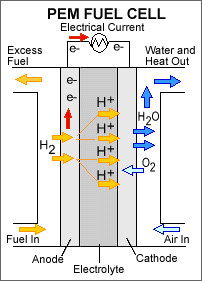
There
are many different types of fuel cells available. For vehicle purposes,
the most common is the Polymer Electrolyte Membrane (PEM) fuel cell.
Source: Office of Energy Efficiency & Renewable Energy
The
process works by taking fuel (hydrogen) and oxygen molecules into the
fuel cell. Hydrogen is channeled to the anode, and oxygen to the
cathode. They are split through the use of a catalyst, which in most
cases is platinum. The hydrogen splits off into positive hydrogen ions
(protons), and negatively charged electrons. The PEM cannot let the
electrons into the membrane or else it would short circuit the fuel
cell. Once the hydrogen is split, the positive ions flow through the
membrane to the cathode. The electrons that were broken off from the
hydrogen also travel along an external circuit to the cathode, which in
turn creates an electrical current. At the cathode, the electrons and
the positive Hydrogen ions meet with oxygen to form water (H20), which
exits the fuel cell.
There are a few trade-offs
with this system. The first is the use of platinum as a catalyst for the
breakdown of the molecules. Platinum is an expensive material, and
without a replacement catalyst or a reduction in price fuel cells will
always be expensive to produce. Secondly, separating oxygen
significantly reduces electricity that can be generated due to the
difficult nature of splitting oxygen molecules, which makes the process
of producing electricity from the circuit less efficient.
Fuel
cells are also extremely sensitive to any permutation in the system.
Electrons need to flow through the proper channels; they cannot leak
into the membrane where the positive hydrogen ions pass through to meet
oxygen. Furthermore, hydrogen is volatile to store. In order to safely
house hydrogen, fuel tanks in cars need to maintain pressure in a PSI
range of 5000-10,000.
Infrastructure
While
fuel cell technology has advanced in recent years, the infrastructure
for hydrogen refueling stations is currently not where it needs to be
for fuel cell vehicles to become mass-market. This issue seems to be the
Achilles heel of fuel cell vehicles, as a lack of refueling stations
would lead to marginal sales volume. However, major investment into
hydrogen fueling networks have begun in California and the Northeastern
states. With time and capital, the network of hydrogen refueling
stations will continue to grow as fuel cells gain efficiency and
popularity.
California has been the leader in
support of zero-emission vehicles; offering rebates in the range of
$3000-$5000. In 2014, the California Energy Commission announced
it would invest $46.6 million to speed the development of hydrogen
fueling stations, with the hope of reaching the goal of 100 refueling
stations that would allow for the commercialization of FCVs in
California. The state is planning to double the number of hydrogen
refueling stations that are currently available this year. According to
the California Fuel Cell Partnership, there are twelve available
hydrogen refueling stations in California. The map also shows about another 30 retail locations that are in development. In an interview, Hyundai Motor America CEO David Zuchowski anticipates 40 refueling stations to be open before the year's end of 2016.
Though California is the testing ground for new technology, Toyota sees promise in the Northeast. Toyota
is helping to develop and supply, with the help of France's Air
Liquide, twelve hydrogen refueling stations in Connecticut,
Massachusetts, New Jersey, New York, and Rhode Island. The plan for
Northeastern hydrogen refueling stations is part of a broader coalition
called The Northeast Electrochemical Energy Storage Cluster (NEESC).
NEESC has outlined hydrogen and fuel cell development plans for eight
states located in the Northeast, with the goal to "increase awareness
and facilitate the deployment of hydrogen and fuel cell technology."
Further advancing infrastructure, eight Northeastern states have signed a
memorandum of understanding that would require manufacturers to sell
3.3 million zero emission vehicles in the geographic area. This figure
includes both FCVs and EVs. The NEESC has a goal of 110 hydrogen
refueling stations by the end of 2018 in the Northeast.
Another
alternative is the installation of hydrogen refueling stations at
already established gasoline stations. The move would make sense, as a
shift to EVs in the United States and in Europe would affect the
revenues of oil companies. However, providing hydrogen alongside
traditional gasoline at these stations would create the opportunity for
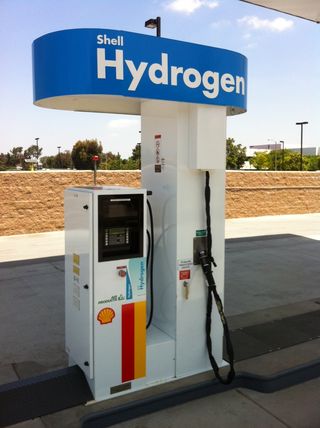
an additional revenue stream, while maintaining the core business. Shell
has been adopting hydrogen fueling stations to select locations in California, with plans to add more in the future.
Through
the use of existing stations, building the infrastructure needed for
mass-market hydrogen consumption is the most realistic. The problems
that are associated with hydrogen, such as transportation and storage,
would be alleviated by direct lines to the pump at the gas station. As
well, many states derive tax revenue for the building and fixing of
roads, bridges, and highways from gasoline taxes. With a gradual shift
from gasoline to hydrogen, oil companies can maintain relevance, while
the state can still collect taxes on the fuel coming out of the pump.
The current amount of
capital needed to add-on or build a hydrogen refueling station totals $1
million, yet, the actual cost comes closer to $1.5 million, according
to Hyundai Motor America CEO David Zuchowski. While electric charging
stations typically require
an average of $250,000 to install, hydrogen refueling stations require
more intensive construction and maintenance. Despite needing the
additional capital to fund the infrastructure, the business perspective
paints a clearer picture.
A typical EV takes around 8-14 hours for level 1 charge (120 volt AC) or 4-9 hours for a level 2 charge (240 volt AC). Tesla's supercharger only recharges around 50%
of the battery after 30 minutes. The supercharger is not a public
charging station or high voltage outlet, and requires a specially built
station to output 120 kW of DC power. Consequently, batteries are not
like gasoline or fuel cell vehicles in the way that the car must reduce
the current above a certain percentage to top off the battery. With that
in mind, it would take Tesla's supercharger nearly 75 minutes to fully
charge a 90 kWh Model S.
From the hydrogen
perspective, a FCV takes no more than 3-5 minutes to fill up. Given the
early stages of hydrogen refueling station technology, that time
estimate would likely drop with advancements. To a business, the number
of electric charging stations required to satisfy public demand would be
at least four to five times the amount comparable to hydrogen stations.
That also assumes that EVs can be charged 50% in a decent amount of
time, much like the Model S. From that point of view, electric charging
stations do not seem to make much sense for any business to own and
operate, as home recharging would seem like the only viable solution to
consumers.
Models
Development
of FCVs have been underway for years. Hyundai released their first FCEV
(Fuel Cell Electric Vehicle) in 2001 with the Hyundai Sanata Fe FCEV.
Honda's first delivered model of fuel cell cars was the 2002 FCX. Over
the past year, there have been numerous car companies expanding their
lineup to include new FCVs. As production costs associated with fuel
cells declines, more auto manufacturers will begin creating models that
can leverage the new technology. A list of recent models produced by
different companies is as follows:
Audi - A7 H-Tron Quattro
Honda - FCX Clarity
Hyundai - Tucson Fuel Cell
Mercedes-Benz B-Class F-Cell
Toyota - Mirai
Focusing on the Toyota Mirai which was recently released, how does it compare against a similar style EV? The Volkswagen (OTCPK:VLKAY)
E-Golf is a sedan EV that is roughly the same in dimensions and weight
as the Mirai, making for a good study in the differences between FCVs
and EVs. The Volkswagen E-Golf starts
at a base MSRP of $29,800, with a 24 kWh battery and an EPA range of 83
miles. The base model does not come equipped with a 7.2 kW onboard
charger, and instead has a level 2 charger rated at 3.6 kW. Charging to
full takes roughly four hours for the base model. If the 7.2 kW onboard
charger is added, the time is reduced to around two hours. The motor
outputs 115-hp and 199 lb-ft of torque.
The Toyota Mirai, meaning "future" in Japanese, starts
close to $58,500. The Mirai also qualifies for federal tax and state
tax credits like EVs do. Toyota offers three years of complimentary
hydrogen fuel to all new buyers, which can be seen as a $10,000 value if
it is assumed hydrogen fuel prices maintain parity with gasoline.
Refueling takes only about 5 minutes, and on a full tank of hydrogen the
car gets an estimated 312 mile range. The electric motor powering the
Mirari outputs 151-hp and 247 lb-ft of torque.
Even
though this is one comparison, the differences are evident. Barring the
price difference, the Toyota Mirai beats out the Volkswagen E-Golf in
range, fill time, and power. The only major distinguishing factor is the
price. Electric vehicles have been in production for a better part of
the last decade, and it should come as no surprise that they will be
cheaper than new fuel cell powered vehicles. Once cheaper materials and
more efficient fuel cell stacks are created, the price of FCVs will come
down to match EVs, making FCVs more economically beneficial.
Consumer Perspective
The
battle over which zero-emission vehicle is more efficient is
meaningless if the consumer perspective is discounted. Consumers have
grown accustom to using gas stations as the means to fill their car up.
The difference between charging an EV, which might take up to 14 hours
depending on the voltage being used, or five minutes that it takes to
refill a FCV cannot be understated. In today's fast-paced environment,
the need to charge a car every day or two can simply become an
inconvenience.
The negatives of EVs do not
stop from a time standpoint, but also from an efficiency standpoint. On
average, EVs have their range reduced by 57%
in cold weather (20 degrees Fahrenheit), and 33% in extreme heat (95
degrees Fahrenheit). Combined with the fact that EVs have less overall
range than comparable FCVs, the benefits of a FCV become clear. Group
Vice President and General Manager of the Toyota Division, summed up the
benefits of FCVs over EVs best in an interview at the 2014 Chicago Auto Show:
It really provides all the benefits of a plug-in EV without the range anxiety and without the time it takes to recharge it.
Takeaway
What
the future holds for the next generation of zero emission vehicles is
certainly up for debate. Right now, major automotive brands are gearing
up, picking a side and fighting for the zero emission vehicle of their
choice. Toyota, Hyundai, Honda and a few others have already committed
to creating fuel cell vehicles going forward. Stalwart brands, such as
Tesla, Nissan (OTCPK:NSANY), and GM (NYSE:GM) have remained steadfast in their commitment to further developing EVs.
The
difference comes down to practicality and convenience. In the end, the
consumer is what drives the market for any new technology. I fully
anticipate that once the infrastructure for hydrogen refueling is
sufficient FCVs will catch on with car makers and consumers. The
advantages FCVs offer over EVs are numerable, and with each passing day
fuel cell technology improves.
To a company like
Tesla whose core brand is built around all-electric vehicles, this
paradigm shift presents a problem. Every other car company can adapt to
changing market conditions by offering products that consumers demand.
However, Tesla limits themselves by only offering EVs. Couple the lack
of car options with the poor financial health of the company, Tesla
seems to be in dire straits. Due to the reasons outlined above, I would
recommend staying clear of the stock.
Disclosure:I/we have no positions in any stocks mentioned, and no plans to initiate any positions within the next 72 hours.
I wrote this
article myself, and it expresses my own opinions. I am not receiving
compensation for it (other than from Seeking Alpha). I have no business
relationship with any company whose stock is mentioned in this article.