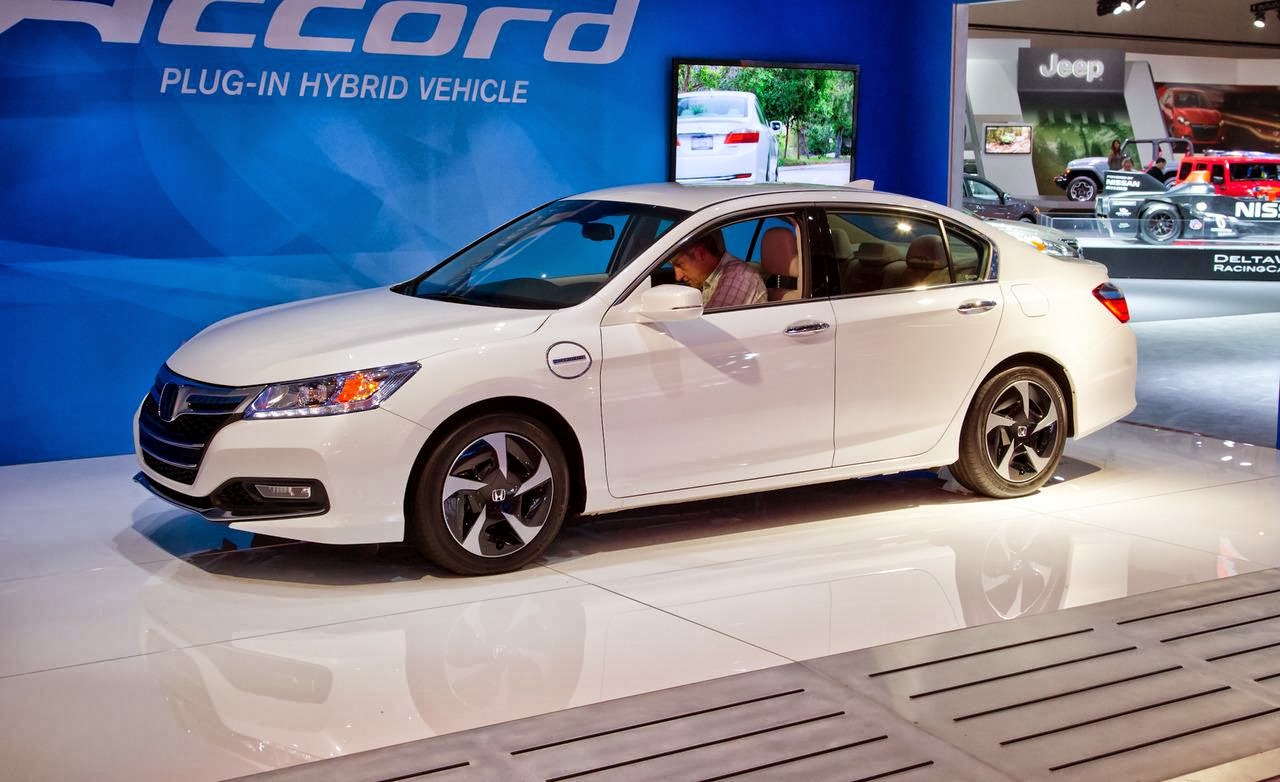
Showing posts with label Next Gen Honda Hybrid. Show all posts

Tuesday, September 12, 2017

2018 Honda Clarity Plug-in Hybrid Achieves Class-Leading All-Electric Range

  • Honda’s all-new, spacious, five-passenger, low-emissions vehicle earned an EPA range rating of 47 all-electric miles
Honda announced the 2018 Clarity Plug-in Hybrid earned the highest all-electric range rating among all midsize plug-in hybrids with its EPA range rating of 47 miles on a full charge1. Launching at dealerships nationwide later this year, the Clarity Plug-in Hybrid also received an EPA fuel economy rating of 110 combined MPGe1, among the top of its class, and a gasoline only 44/40/42 MPG rating (city/highway/combined)1.

"We think the combination of a class-leading 47 miles of all-electric driving range rating and a large, luxurious 5-pasenger package will give us an advantage in the plug-in hybrid game," said Ray Mikiciuk, assistant vice president of Honda Auto Sales at American Honda Motor Co. "The Honda Clarity Plug-in Hybrid represents the dawn of a new era, setting the path to a new generation of Honda products that will bring electrified technology into the mainstream."

For longer trips, the Clarity Plug-in Hybrid can utilize its hyper-efficient 1.5-liter Atkinson cycle 4-cylinder engine to generate electricity and, under certain conditions, to act as a direct power source, resulting in an overall EPA driving range rating of 340 miles1.

The vehicle's electromotive power comes from a 181-horsepower electric motor producing 232 lb.-ft. of torque and drawing power from both the gasoline engine and a 17-kilowatt hour (kWh) battery pack with a recharge time of just 2.5 hours at 240 volts. The Clarity Plug-in Hybrid features three selectable modes – Normal, Econ and Sport – allowing drivers to customize their experience, maximizing efficiency or driving performance. A fourth mode – HV mode – is provided to maintain the battery's state of charge and can be selected in conjunction with Normal, Econ and Sport driving modes.

Expected to be the volume sales leader in the Clarity series lineup, the Clarity Plug-in Hybrid will be offered in two premium-contented trims, standard and Touring.

Honda Clarity Series
The Clarity Plug-in Hybrid is part of Honda’s Clarity series, which includes the Clarity Fuel Cell, launched in December 2016, and the Clarity Electric, launched in August 2017. Clarity is a vehicle series offering customers an array of electrified powertrain choices in one sophisticated, spacious and comprehensively equipped five-passenger sedan, outfitted with premium, environmentally responsible materials.

Offering Honda's "fun-to-drive" DNA, each Clarity variant provides a smooth, quiet and highly refined driving experience, aided by the seamless character of electric drive torque and acceleration. The Clarity series also features advanced technologies, including Display Audio with Android Auto™ and Apple CarPlay™ integration, and the full suite of Honda Sensing® safety and driver-assistive technologies.

The Clarity series is at the leading edge of the Honda Electrification Initiative, which includes the previously announced intention to have two-thirds of Honda's global automobile sales come from electrified vehicles by 2030.  This initiative includes a new dedicated hybrid car launching next year, an all-new Accord Hybrid, the Clarity series, and the expanded application of Honda's two-motor hybrid and plug-in hybrid powertrains to multiple car and light truck models in the future.

1. Based on 2018 model-year EPA ratings. Use for comparison purposes only. Your MPG/MPGe and range will vary depending on driving conditions, how you drive and maintain your vehicle, lithium-ion battery pack age/condition and other factors.

Tuesday, March 1, 2016

2018 Toyota Prius vs Honda Insight: Rivalry Hinted To Resume

Hmmm.... not sure what to think about this....
Toyota Prius
While the EV segment more or less began with a rivalry between the Toyota Prius and Honda Insight, there has been a major shift over the years as the Prius soldiers on whereas the Insight is nowhere to be found.

An interesting possibility has surfaced, as the Insight could be brought back to life as Honda wants to develop a fleet of EVs in the coming years.

As per the CEO of Honda, Takahiro Hachigo, the company has set 2030 as a quasi-deadline to have two thirds of its roster comprising of EVs. For that endeavor hydrogen fuel cell (FCEV) vehicles are being pushed back with plug-in hybrids and hybrids being the primary focus for the near future.
Besides offering the 2017 Honda Clarity FCEV in both hybrid forms, Honda is looking to bring in a dedicated plug-in hybrid the subsequent year.

There is no word on its name but a return of the Honda Insight would be more than welcome. The Prius isn’t doing particularly well in a commercial sense, but it has taken a good stride forward with its technical advancements. Could Honda bring in a PHEV that can match the Toyota New Global Architecture underpinning the Prius?

Source;
http://dailysunknoxville.com/2018-toyota-prius-vs-honda-insight-rivalry-hinted-to-resume/92002908

Thursday, February 20, 2014

PaulTan.org: Honda Malaysia to introduce five new models in 2014

by Danny Tan of www.paultan.org

Honda Malaysia will launch five new models this year. The five includes FMC (full model change) and MMC (minor model change) models and CKD hybrids locally assembled at HM’s Melaka plant. This was announced by Yoichiro Ueno, MD and CEO of Honda Malaysia at the company’s 2014 media gathering. He also gave away the fact that there will be TWO CKD FMC hybrid models.

“We have laid the foundations to strengthen the company’s operations in order to elevate our business to the next level in terms of sales volume, market presence and branding. With the completion of the No.2 Line at our factory and new main models including CKD hybrid to be introduced this year, we believe that our strategies are in line with the current market situation where more people are longing for affordable, environmental friendly and good value for money vehicles,” Ueno said.

The Honda boss also said that two affordable models will be launched this year. The new City, now open for booking, is classified as such, and we can safely assume that the other one is the new Jazz, which will be introduced in the second half of 2014.

All these will contribute to the brand’s lofty sales targets of 76,000 units in 2014, which is 47% higher than 2013 sales. Should they acheive 76k units, Honda will command 11% market share based on a projected TIV of 670,000 units. Of the total, HM is looking to sell 9,000 units of hybrid cars.

Source;
http://paultan.org/2014/02/20/honda-malaysia-introduce-five-new-models-2014/

Tuesday, October 8, 2013

Honda Plots U.S. Hybrid Resurgence Starting With Accord

Honda Motor Co. (7267), first to sell hybrids in the U.S., plans a gasoline-electric lineup overhaul starting with an Accord Hybrid it says tops Toyota Motor Corp. (7203) and Ford Motor Co. sedans as it seeks relevancy in the segment.

The 2014 version of Tokyo-based Honda’s flagship sedan goes on sale Oct. 31, with a base price comparable with a V-6 engine version of the Accord, and that’s rated as getting 50 miles (80 kilometers) per gallon in city driving. That’s just the start, said John Mendel, executive vice president of the U.S. unit.

Honda needs better-selling hybrids. Current models, including the Insight hatchback, CR-Z coupe and a version of the Civic, generate a fraction of Prius deliveries. Honda’s Insight beat the Toyota hybrid to the U.S. by about six months. Yet the company that led U.S. fuel economy ranking for years stumbled in designing a compelling challenger to Prius.

“Accord is a great place for us to stop the science experiments and really make a name for our hybrids,” Mendel said in an interview in San Antonio last week. “We’re known for fuel economy, but in hybrids, it’s about relevance and volume. We think Accord can do that.”

The Accord Hybrid’s label rating, a combined 47 mpg in city and highway driving based on U.S. government tests, ranks it behind only Prius, a mid-size car that averages 51 mpg in the city, 48 mpg on the highway and 50 mpg combined, the best of any non-rechargeable vehicle in the U.S.

While Ford (F)’s Fusion hybrid is also rated 47 mpg combined, Ford faces lawsuits claiming the car’s mileage is overstated. Toyota’s hybrid Camry averages a combined 41 mpg.

Prius’ Shadow

Toyota expects to sell 250,000 Prius models this year. By comparison, Honda’s current hybrid line is on a pace to sell about 19,000 vehicles this year.

Combined sales of hybrids, plug-in hybrids and battery-only autos are headed for a record this year. Through September U.S. car buyers bought about 450,000 such vehicles, based on data compiled by Bloomberg, up 28 percent from about 352,000 a year earlier. Last year was a record for electric-drive vehicles, with sales of about 475,000 cars and light trucks.

Honda anticipates sales of Accord Hybrid, priced from $29,155 to $34,905, will fall in the “2,500 to 4,000” units per month range of Ford’s Fusion Hybrid and the Toyota Camry Hybrid, Mendel said.

The Accord Hybrid’s new two-motor powertrain has components adapted from Honda’s futuristic FCX Clarity hydrogen fuel-cell sedan and battery-electric Fit EV, Hiroo Shimada, the chief engineer who oversaw development of the Accord system, said in an interview.

Accord Sales

The Accord is the second-best-selling mid-size sedan in the U.S. this year, with 282,102 deliveries, behind Camry’s 318,990. The pattern has changed little for more than a decade.

Following the Accord, the company this year also releases a three-motor, all-wheel drive “sport hybrid” version of the premium Acura RLX sedan. A variation of its so-called SH-AWD powertrain will also be used in the 2015 NSX supercar Honda plans to build in Ohio, the company said.

For lower-priced small vehicles, Honda has a new single-motor, dual clutch powertrain that’s being used first on a version of the new Fit subcompact that’s gone on sale in Japan.

There’s no plan to sell Fit hybrids in the U.S. Still, the car’s gasoline-electric system may appear on other models, Mendel said.

“It’s a surprisingly fuel-efficient system,” he said.

New Models

New Honda and Acura hybrids are in the works, in part to help the company comply with the U.S. government’s push to double the average fuel efficiency of new vehicles by 2025, as well as to address volatile fuel prices, Mendel said. The company also wants to burnish its reputation as an industry leader in fuel economy and advanced technology, he said.

Accord Hybrid “can be a great entry point to establish our manufacturing prowess and development expertise in the hybrid area,” Mendel said. “Fifty miles a gallon is going to cut through.”

Honda’s American depositary receipts fell 1.2 percent to $37.91 at the close yesterday in New York. They have gained 2.6 percent this year, compared with a 14 percent advance in the benchmark NYSE Composite Index.

Source;
http://www.bloomberg.com/news/print/2013-10-07/honda-plots-u-s-hybrid-resurgence-starting-with-accord.html

Friday, August 9, 2013

2015 Honda Fit: 86 mpg from the next hyper-efficient hybrid


Could your next car get 86 mpg? It might if it’s a Honda. The next-generation Honda Fit subcompact will be unveiled this fall and arrive in the US in the first half of 2014. Most of the buzz over the new Fit, called the Honda Jazz in some countries) is the hybrid version, which promises a 35% improvement in fuel economy. The US currently gets the gasoline Honda Fit and EV Fit — not the hybrid Fit — but that could change with the next model.

On a Japanese test cycle, 2014 Fit Hybrid fuel economy will be on the order of 2.7 liters consumed per 100 km or 85.6 US mpg. That’s a mathematical conversion that doesn’t account for the US test cycle. But still, it could be the most efficient hybrid if and when it arrives stateside. Currently the most efficient non-EV cars sold in the US are the Toyota Prius C and Toyota Prius, each with 50 mpg combined EPA rating, 53 mpg and 51 mpg city ratings for the Prius C and Prius, respectively. The 2013 Honda Fit gets 29-31 mpg combined depending on the transmission or 33-35 mpg highway; the Honda Fit EV gets 118 mpg-e (miles per gallon equivalent), best in the category the EPA calls small station wagons.

Atkinson engine, 7-speed double clutch transmission, electric motor

Under the umbrella of Honda’s Earth Dreams Technology program, the new Fit Hybrid will be the first to employ Honda’s Intelligent Dual Clutch Drive system, or i-DCD. The gasoline power comes from a 1.5-liter, four-cylinder Atkinson cycle engine. A single electric motor is packaged with a seven-speed dual clutch transmission, linked through an intelligent power unit (IPU) to a lithium-ion storage battery. An Atkinson engine has an effectively shorter compression stroke (when the piston moves upward) than the downward power stroke, accomplished by not immediately closing each cylinder’s intake valve. It captures more of the power in the fuel-air mixture.

When starting out, the clutches disengage the gas engine and the Fit Hybrid starts off on battery power. The clutches engage the engine and gearbox under sporty (hard) acceleration and at higher speeds. When the Fit Hybrid decelerates, the gas engine is again disengaged.
Honda i-DCD diagram
Honda has claimed a 35% increase is compared to the current Fit Hybrid’s integrated motor assist (IMA) configuration. The IMA electric motor only runs when the gasoline engine runs, functioning much like a turbocharger. This is called a mild hybrid or weak hybrid configuration. A hybrid such as the Prius that can run on battery power alone is a strong hybrid, and who wouldn’t prefer strong over mild, let alone weak?
IMA may be cost-effective tech, but lots of hybrid owners want to see — and show their friends — a car that runs on battery alone for a mile or two. This is what happens when you let engineers have input into how a company runs: They pick solutions that make cost-effective sense. Sometimes the market agrees, other times not. Honda has long argued nobody needs an engine of more than six cylinders and it turns out they’re right, but that hurt the Acura brand competing against V8 offerings from Lexus, Audi, BMW and Mercedes-Benz the last two decades. Honda has also been one or two gears shy of the competition in transmissions, arguing that four or five forward gears was  fine — “look at our mpg figures, not the numbers of gears.” Now, they too are creeping upwards to as many as seven (the industry record is currently nine). The IMA hybrid is giving way to the i-DCD hybrid. At the very least, IMA served its purpose and Honda is moving on to a more efficient technology.

Source;
http://www.extremetech.com/extreme/163462-honda-fit-86-mpg-from-the-next-hyper-efficient-hybrid

Friday, August 2, 2013

Automobile Mag: 2014 Honda Accord PHEV Driven

by Anne White www.automobilemag.com

There's something a little unsettling about driving the 2014 Honda Accord Plug-in Hybrid in all-electric mode. Press the push-button start, and the dash lights up and tells you the car is ready to go. But if you're waiting for the reassuring grumble of an engine turning over, you're going to be waiting a long time. This Accord is riding the wave of the future, and where it's going, you don't need (as many) gas pumps.  

The 2014 Honda Accord Plug-in Hybrid hit dealer showrooms in January 2013. With an EPA rating of 115 mpg-e combined, it is one of the most efficient cars money can buy. The Accord PHEV owes that rating to its 6.7 kWh battery, which Honda says can give drivers up to 15 miles of all-electric range when fully charged.

Is fifteen miles of range enough?
By adopting a sedate driving style and sticking to city streets, where the Accord PHEV can make the most of its regenerative braking capability, it's fairly easy to drive ten or more miles without engaging the 137-horsepower, 2.0-liter 4-cylinder engine (combined with the electric motor, net system output is 141 hp). Still, we eked out a full 15 miles of battery-powered travel just once during our weekend with the Accord.


Driving at high speeds and using climate control will significantly decrease electric driving range. And forget about full-throttle acceleration. The Accord Plug-in can travel in electric mode at speeds of up to 80 mph, but anything other than light acceleration will make the gasoline engine kick in to lend a hand.  

For our purposes, the Accord PHEV proved perfect. Our short commute on city streets with a 240-volt charging port at the end of it makes us the ideal customer for a plug-in hybrid. The car charges in just an hour with a 240-volt outlet and three hours with a 120-volt outlet, so by lunchtime the Accord is topped up and ready to go. (The speed of battery charging is the real differentiator in plug-in hybrids and EVs, we've found.) Plug it in again after lunch for the drive home, and we've gone 24 hours and almost as many miles without a drop of gasoline. 

Plug-in means flexibility
Left to its own devices, the Accord Plug-in automatically depletes its battery charge before switching to its gasoline engine. Yet drivers can also elect to save battery charge for later, say if they're driving fifty miles on the highway before ending up on city streets, which is a worthwhile feature.


We like plug-in hybrids because the gasoline engine offers flexibility for drivers who sometimes need more range than a fully electric car could offer, just as in our weekend trip to darkest Indiana. Yet the Accord Plug-in is by no means a family road trip car, as we discovered. Why? Two words: trunk space. Because of the big battery pack, there's hardly room for a couple of overnight bags back there, so forget about packing a volleyball net or a few bags of groceries. If you're traveling in the Accord PHEV, you'll be traveling light.  

The 2014 Honda Accord Plug-in is good at what it does. It returns truly impressive gas mileage, drives well in the city and on the highway, and makes up for its short battery life with a very quick recharging time. Passengers found the ride smooth and were impressed by the car's standard technology, like a blind-spot camera that turns on when the right turn signal is engaged. The Accord PHEV suffers from slightly dorky "Look, I'm an EV!" styling -- those aerodynamic wheels may help fuel economy but they're not going to help you get a date -- but its crimes of fashion aren't egregious.

Better than the competition?
Good it may be, but how does the 2014 Honda Accord Plug-in stack up to the competition? It's a fairly even fight. The Ford Fusion Energi gets up to 21 miles of electric range, and it's available with leather seating, while the Accord is only available with Honda's tacky, eco-friendly cloth seats. Both cars start right around $40,000. Both are eligible for federal tax credits -- $3,750 for the Fusion Energi and $3,334 for the Accord Plug-in. 


They'll both serve you well, if a plug-in hybrid is what you're looking for. What's not clear is just how many people are looking for them. The Honda Accord Plug-in has sold just 200 copies in six months in the two states where it's available, California and New York. Honda says it's only planning to sell 1,100 of the vehicles in a two-year period, so don't expect to see them on every corner.

Source (with lots of other pic's);

Wednesday, February 27, 2013

Edmunds: 2014 Honda Accord Plug in Hybrid

Pros

Plug-in hybrid technology; high fuel economy; premium feel interior; loaded with standard safety and convenience features; quick recharging times.

Cons

Considerably more expensive than the typical hybrid sedan; no folding rear seat.

What's New for 2014

The 2014 Honda Accord Plug-In Hybrid is an all-new model.

Introduction

Honda recently redesigned the Accord for its ninth generation, improving the sedan's interior and exterior styling. For 2014, the Honda Accord gains a new model, the Accord Plug-In Hybrid. With this new addition to the lineup, Honda becomes one of the few automakers to offer a midsize family sedan in a plug-in hybrid configuration.
Unlike Honda's other hybrids such as the Insight, the Plug-In has an all-new hybrid system that's capable of accelerating the car using pure electric power. And as its name implies, the Plug-In can be recharged externally, thereby minimizing gas usage. Honda says the Accord Plug-In provides about 10-15 miles of pure electric range, after which point it switches over to normal hybrid operation. In regular hybrid mode, this Accord earns EPA estimates of 47 mpg city/46 mpg highway and 46 mpg combined.
Like the standard Accord, the plug-in hybrid offers similar features and comes in one well-appointed trim level based on the standard Accord Touring trim. That includes LED headlights, a rearview camera, Bluetooth, a navigation system and monitoring of vitals like charge status, charging stations and even enabled remote charging controlled by smartphone apps. Honda says a full battery charge on a 120-volt outlet will take three hours, while charging on a 240-volt outlet takes less than one hour.
The family sedan segment is packed with more great choices than ever before, but the field is wide open for plug-in hybrids. For now, the Accord competes directly with the 2013 Ford Fusion Energi, which, like the Accord, bundles a lengthy list of winning features into a plug-in package. One could also consider the 2013 Chevrolet Volt. It offers approximately three times the electric-only range, though it only seats four and those in back will find cramped quarters compared to the Honda.
For now Honda will only sell the Accord Plug-In Hybrid in California and New York, so consider yourself lucky if you're interested in the car and happen to live in one of those states. We've yet to fully test the 2014 Honda Accord Plug-In, but check back for a complete evaluation in the coming months.

Body Styles, Trim Levels, and Options

The 2014 Honda Accord Plug-In Hybrid comes in one well-equipped trim level.
Standard features include 17-inch alloy wheels, LED headlights, foglamps, dual-zone automatic climate control, full power accessories, a rearview camera, adaptive cruise control, a tilt-and-telescoping steering wheel, an auto-dimming rearview mirror, special "bio-fabric" upholstery, heated front and rear seats, an eight-way power driver seat (with power lumbar), driver memory settings and a leather-wrapped steering wheel. Electronic features include Bluetooth connectivity, an 8-inch touchscreen interface, voice recognition, a navigation system and a six-speaker sound system with satellite radio, an iPod/USB interface and smartphone app integration (HondaLink). Adaptive cruise control, lane-departure warning and a blind-spot monitor are also standard.

Powertrains and Performance

The 2014 Honda Accord Plug-In Hybrid is powered by a 2.0-liter four-cylinder engine combined with an electric motor. Together, they send a total of 196 horsepower to the front wheels through a continuously variable transmission (CVT). A 6.7 kWh lithium-ion battery pack powers the electric motor.
The Accord Plug-In Hybrid offers three driving modes: full electric, gas/electric (switches when battery capacity depletes to a specific threshold) and gasoline (for higher speeds or under high demand for acceleration). Additionally, two sub-modes tailor the Accord Plug-In's hybrid mode. "HV" acts as a conventional hybrid, blending gasoline and electric power for optimum fuel efficiency, while "HV Charge" does the same, while feeding energy back into the battery.
The EPA estimates stand at 47 mpg city/46 mpg highway and 46 mpg combined.

Safety

The 2014 Honda Accord Plug-In Hybrid comes with antilock disc brakes, stability and traction control, active front head restraints, front seat side airbags and side curtain airbags. Blind-spot monitoring, lane-departure and forward-collision warning systems are also standard.
Of note is the LaneWatch blind-spot system, which instantly switches the 8-inch screen's display to a low and expansive view of the passenger side of the car when the right turn signal is engaged. A camera in the right-side mirror dedicated to this function provides a confidence-inspiring view, and acclimating to catching the view in the center-dash display is quick and natural.

Interior Design and Special Features

With a few exceptions, the 2014 Honda Accord Plug-In Hybrid features an elegant and well-constructed cabin trimmed with high-quality materials that you could almost mistake for an Acura. The center stack embraces the spirit of legibility with an effective three-tier layout, capped at the top with an 8-inch display.
Despite the new Accord's slightly smaller exterior dimensions compared to the previous generation, its interior room remains impressive. There is plenty of leg and shoulder space for front occupants, and rear-seat passengers should be quite comfortable and happy. Road and tire noise -- often among Honda's traditional weaknesses -- are noticeably reduced in the 2014 Accord thanks in part to two active noise-cancellation systems plus improved aerodynamics.
We're also fond of the visibility afforded by the Accord cabin, which offers a lower beltline, slimmer roof pillars and a generous amount of glass. Unfortunately, the presence of the plug-in hybrid's battery pack means the rear seat does not fold down, thus limiting the Accord's cargo usefulness. The trunk, at 8.6 cubic feet, is also considerably smaller than the regular Accord's.

Driving Impressions

We've yet to test the 2014 Honda Accord Plug-In Hybrid, so check back for impressions on the car's new plug-in hybrid powertrain and handling capabilities.

Source;
http://www.edmunds.com/honda/accord-plug-in-hybrid/2014/

Friday, February 22, 2013

PaulTan.org; Delving into the details – interview with Norio Tomobe, Large Project Leader of the new facelifted Honda CR-Z

DSC 7929 630x293 Delving into the details   interview with Norio Tomobe, Large Project Leader of the new facelifted Honda CR Z Photo
By now we’d assume that you’ve read our comprehensive launch report of the facelifted Honda CR-Z from yesterday. We were first to report the car’s surprise world debut at the Indonesian International Motor Show last September, and then covered its European premiere at the Paris Motor Show a week later.

We’ve driven the facelifted car in Japan too, taking it out for a short spin around the Twin Ring Motegi Speedway in Tochigi. Closer to home, we’ve tested both the manual and CVT variants of the original CR-Z. It’s safe to say that we’ve covered the Honda CR-Z a fair bit, but we’re not done yet!

Here comes an extensive interview with the new CR-Z’s Large Project Leader, Norio Tomobe we had the privilege to meet earlier this week. Read about everything you’ll ever want to know about the updated hybrid coupe – from its new lithium-ion battery to the possibility of a more powerful version. Yes, yum indeed.

DSC 7944 630x341 Delving into the details   interview with Norio Tomobe, Large Project Leader of the new facelifted Honda CR Z Photo
How does the new battery differ in terms of performance as compared to the old one?
By quite a bit actually. Positively of course. Both voltage and power outputs are increased by 44% each. Effectively the battery performance alone is up to 1.5 times better, and the charging rate is 1.5 times faster too. And as the capacity is bigger, we can store more and output more as well.

The new battery weighs the same as the old one, but has a slightly smaller size. It’s packaged in the same place as before, which is in the boot as to not alter the CR-Z’s perfect weight distribution or handling balance.

Does the use of a new battery improve fuel efficiency?
Yes, of course. Over the Japanese-standard JC08 cycle, the new CR-Z uses 0.2 litre per 100 km less than before despite being quicker and more powerful.
DSC 7941 630x345 Delving into the details   interview with Norio Tomobe, Large Project Leader of the new facelifted Honda CR Z Photo
Has the suspension or anything else been changed to support the extra performance?
Yes, the clutch in the manual gearbox has been beefed up to support the additional power. The CVT stays the same. We have revised the front stabiliser and dampers for better response. In Japan, we offer bigger 17-inch wheels so the changes are also done to support that option.

Why does the manual variant get more horsepower than the CVT?
With CVT, the engine growl is higher as it sticks to a higher rpm for prolonged periods. To solve this problem, we’ve used a different silencer on the CVT models which explains the slight difference in power between the two variants.

What is the current demand split between the manual and CVT variants?
For Malaysia it’s 90% CVT and 10% manual, whereas in Japan and America, the model split is closer to 70-30 (%).
DSC 7949 630x348 Delving into the details   interview with Norio Tomobe, Large Project Leader of the new facelifted Honda CR Z Photo
Regarding the S+ button, was it something that the existing customers want, or was it a planned addition?
I’m a BMW fan and in my Z4, I like the fact that it has a Sport + function on top of the standard Sport mode to offer a different driving feel. It was too late to implement it into the original CR-Z so for the facelift model, I personally suggested the implementation of an S+ mode.

It’s basically just a software setting, where when the button is pressed, the electric motor pushes out 100% assist power and the throttle opens fully. Effectively it works like a boost button. Paired with the CVT, it will also trigger appropriate downshifts for maximum acceleration.

As a performance benchmark, when you press the S+ button while travelling at 100 km/h, it will only take 7 seconds to reach 180 km/h.

Since the S+ plus button is on the steering wheel and operates the engine performance, can it be dangerous if activated through tight corners?
No, it’s perfectly safe. The electronics will sense the cornering and steering angle before activating the S+ mode. In a straight line or a smooth curve, it will provide the necessary performance kick. But if the steering is turned tightly and there’s a chance of losing traction should the boost be triggered, the system will be cut off.
DSC 7951 630x349 Delving into the details   interview with Norio Tomobe, Large Project Leader of the new facelifted Honda CR Z Photo
Regarding the exterior changes, is it purely cosmetics or are there any aerodynamic benefits?
The mesh grille on the new car would actually affect the aerodynamics, but we’ve managed to monitor the situation so in the end, we changed the cosmetics without having any detrimental effects on the aerodynamics.

A hybrid’s battery is always a big concern among consumers, even with the long and comprehensive warranty package that Honda Malaysia offers. How long can the CR-Z’s new lithium-ion battery last?
As with all of our hybrid vehicles, the CR-Z was developed to adhere to all existing regulations globally, especially concerning the battery. At the moment, the strictest standard is the American Emission Warranty, which dictates that the battery must last for at least 15 years and 240,000 km.

The CR-Z, new or old, passes that standard. There is no exact answer on precisely how long the battery can last, but we can commit that it adheres to the American Emission Warranty which again is set at 15 years and 240,000 km.
DSC 7934 630x348 Delving into the details   interview with Norio Tomobe, Large Project Leader of the new facelifted Honda CR Z Photo
So does that mean that if the battery happens to fail before 15 years and 240,000 km, it will be replaced under warranty?
At the moment, Honda Malaysia is giving a battery warranty of five years with unlimited mileage – the same with all of our hybrid models. And this warranty is from Honda Malaysia, not a purchased warranty. Also rest assured that the battery passes the American regulation.

Our hybrid technology has been in development for quite a while already. We have done all sorts of toughness tests in the past years, and we are confident that the CR-Z will not face any problems with the battery.

It’s known that a lithium-ion battery generates more heat in operation than the older nickel metal hydride item. How has this issue been handled?
Yes, a Li-ion battery runs hotter than a NiMH power cell. To counter this effect, we have equipped an improved cooling system to the battery pack itself to control its operating temperature. There’s now a cooling fan next to the battery pack.

The new CR-Z has four battery modules, each with 10 cells. There’s a temperature sensor placed on each module to monitor the heat, and the cooling system is very efficient to ensure that the battery modules stay within their optimum operating windows. We’ve done numerous tests on the new CR-Z, toughness tests, and we’ve never had the battery overheat (on which situation it would shut down and go to power save mode).
DSC 7940 630x344 Delving into the details   interview with Norio Tomobe, Large Project Leader of the new facelifted Honda CR Z Photo
Can the outgoing CR-Z be retrofitted with the new Li-ion battery?
No, because the operating computer system and ECU are totally on different settings. To swap all the necessary components to allow the change would be very challenging and anyway it can’t be done at a Honda dealer, as there won’t be any supporting warranty for it.

As the two models now have very different batteries, for how long will Honda stock up the replacement parts for the old model?
Ten years after production stops. That’s a standard procedure at Honda across all production models, so in the old CR-Z’s case, it will be until 2022.
DSC 7947 630x348 Delving into the details   interview with Norio Tomobe, Large Project Leader of the new facelifted Honda CR Z Photo
With the recent floods, how well is the battery protected should it encounter such situations?
Basically, if it is completely submerged under water then it will fail. It is water resistant in the sense that it’s protected to not let water filter through into the battery pack, but it’s not waterproof. It’s not like a G-Shock, it can’t work under water. If that happens, there’s a failsafe system that shuts down the battery to avoid electrocution.

To reaffirm this, the battery is well protected. For example if you put wet items in the boot, the water will not affect the battery. It’s insulated against that. Also, all Honda hybrids are thoroughly tested by driving through 30 cm of water at a certain speed without being damaged.

Feedback from current hybrid owners suggest that the cabin can get a bit warm when the engine shuts down automatically in heavy traffic. Has Honda found a fix for this?
In terms of whether we’ve improved the situation compared to the old CR-Z, the answer is no. Only the latest Civic Hybrid has a different compressor to control the air con separately with the engine off.

For the new CR-Z, Jazz Hybrid and Insight, the issue is handled by manipulating the idle stop operation, where as soon as it detects the cabin temperature rising, the engine will start automatically. For the hot Malaysian climate, the idle stop is set to start the engine sooner.
DSC 7930 630x349 Delving into the details   interview with Norio Tomobe, Large Project Leader of the new facelifted Honda CR Z Photo
As fast as it is, there will always be Honda enthusiasts who wish for something faster. Will there be a more powerful version of the CR-Z in the future, perhaps with a larger hybrid engine or even conventional petrol powerplant?
There already is a faster version, and I was personally involved in the Mugen RZ project – that 300-unit limited run CR-Z that has 170 hp. But the basic concept of the CR-Z when I first developed it was to add a new value to the world, to the fans out there. The CR-Z excels in both fuel efficiency as well as performance.

Honda as a company always promotes the sportiness of the product itself. Like what our president Takanobu Ito has mentioned, the NSX will be coming out soon. As you know, the NSX will cost you a bomb to buy, while the CR-Z is the attainable mass-market sports car for the public.

But to answer whether there will be a more powerful version of the CR-Z, why, yes, you can expect that. The CR-Z has another 10 years left in its life cycle, so moving forward, it will always be improved until the next one appears.
DSC 7932 630x350 Delving into the details   interview with Norio Tomobe, Large Project Leader of the new facelifted Honda CR Z Photo
In Japan at the moment, there isn’t a significant demand for more performance, as fuel efficiency is still a priority. If there is enough demand for it, I would personally like to answer that demand. That’s so to say that it is not out of the question.

The CR-Z has been designed as a hybrid, so there won’t be a pure petrol version of it. But, if I were to imagine a more sports-oriented version of the CR-Z, a hybrid and turbo combination would be ideal.

A turbocharger works at its best beyond 2,000 rpm, while the hybrid system is more effective below that engine speed. If we can combine these two together, that would be the best combination to achieve optimum fuel efficiency as well as power.

Source;
http://www.paultan.org/2013/02/22/delving-into-the-details-interview-with-norio-tomobe-large-project-leader-of-the-new-facelifted-honda-cr-z/


Thursday, January 10, 2013

Honda to build new Accord hybrid car in U.S.

DETROIT (Reuters) - Honda Motor Co Ltd said on Thursday it will invest $23 million to build a hybrid version of its popular Accord sedan at its plant in Marysville, Ohio.

The Japanese automaker said it will add about 50 jobs at the plant to build the car, which will go on sale this fall as a 2014 model.

It will be the third hybrid vehicle Honda builds in the United States, following hybrid versions of the Civic and Acura ILX built at the company's Greensburg, Indiana, plant.

The Ohio plant is undergoing an expansion of 95,000 square feet to house assembly processes and logistics specifically for production of the Accord hybrid, Honda said. The project includes lengthening the main assembly line and adding space for related parts receiving and sub-assembly operations.

In the last three years, Honda has announced investments at its Ohio manufacturing facilities exceeding $800 million.

(Reporting by Ben Klayman in Detroit; editing by John Wallace)

Source;
http://news.yahoo.com/honda-build-accord-hybrid-car-u-135224685--finance.html 

Sunday, December 9, 2012

2014 Honda Accord PHEV priced at $40,570 (USD)

By Andrew Christian

The 2013 Honda Accord has already started selling and will get two hybrid versions. Honda took the opportunity at the Los Angeles Auto Show to announce the pricing for the 2014 Accord Plug-In. In addition, Honda confirmed that a regular hybrid model will follow next summer. Honda has already confirmed the Plug-In Hybrid awhile back but has revealed that the Accord PHEV will begin to sell in only a few short weeks. By January 15, buyers in New York and California will be able to get their Accord PHEV, priced from $40,570, including destination costs. A hybrid tax credit has yet to be confirmed. For this price, consumers get an Accord with a design that’s slight different for improved aerodynamics. All of the Accord Touring creature comforts and features (such as forward collision and lane departure warnings, as well as a rear-facing LaneWatch camera) can offer up to 115 MPGe, the EPA said. The Accord PHEV has an electric-vehicle-only range of 13 miles.

At this point, the gasoline engine would kick in. It has an overall fuel economy of 47 mpg city, 46 mpg highway, 46 mpg combined. The range is slightly shorter than extended-range electric vehicles such as the Chevrolet Volt but the outcome is that drivers could recharge their Accord plug-ins in shorter than one hour with a 240-volt charger or three hours with the use of a 120-volt outlet. Furthermore, the Accord PHEV is eligible for California’s vaunted “Access OK” carpool-lane-exemption stickers, which permits single commuters to utilize HOV lanes.

There will be a less expensive hybrid available if the Plug-In costs too much. The 2013 Honda Accord Hybrid will appear more like the Honda Accords with traditional gas engines but it offers 49 mpg city, 45 mpg highway, 47 mpg combined due to its next-generation, two-motor Hybrid system that should offer a performance and economy that’s better than the current Integrated Motor Assist unit. These figures are nearly totally in line with those of the Ford Fusion Hybrid, which claims 47 mpg in the city, on the highway, and in combined driving.

Source;
http://www.4wheelsnews.com/2014-honda-accord-phev-priced-at-40570/

Monday, November 12, 2012

Honda Develops New Lightweight and Compact Hybrid System Named “SPORT HYBRID Intelligent Dual Clutch Drive”

Three Different Honda SPORT HYBRID Systems Accommodate Different Vehicle Characteristics
Honda Motor Co., Ltd. has developed a new SPORTS HYBRID Intelligent Dual Clutch Drive system, a lightweight and compact one-motor hybrid system optimized for small-sized vehicles. This new hybrid system will be the latest addition to the Earth Dreams Technology series of next generation powertrain technology that realizes both excellent driving performance and high fuel efficiency.

Together with the SPORT HYBRID Intelligent Multi Mode Drive, the world's most efficient1 two-motor hybrid system optimized for mid-sized vehicles, and the SPORT HYBRID SH-AWD® (Super Handling - All Wheel Drive), the three-motor hybrid system optimized for large-sized vehicles enabling independent control of torque distribution to both right and left rear wheels, the newly developed SPORT HYBRID Intelligent Dual Clutch Drive will constitute the lineup of three different Honda SPORT HYBRID systems that accommodate different vehicle characteristics. Honda will continue expanding the application of these hybrid systems based on vehicle characteristics.

SPORT HYBRID Systems Lineup
One-motor SPORT HYBRID Intelligent Dual Clutch Drive
In addition to top-level fuel efficiency in its class2, the fun of driving is realized with acceleration g-force more powerful than that of existing models as well as a rhythmic and linear acceleration feeling. This drive unit combines a newly developed inline 4-cylinder 1.5-liter Atkinson cycle engine with a 7-speed Dual Clutch Transmission (DCT) system with a built-in high-output motor and a Lithium-Ion battery to improve efficiency by more than 30 percent compared to a conventional one-motor hybrid system.  
  • The combination of the one-motor hybrid system and the engine realizes sporty driving during acceleration and high-speed cruising by using the clutches to engage the engine  
  • Highly efficient electric vehicle (EV) driving is realized during startup and low- to medium-speed cruising by using the clutches to disengage the engine
  • This system contributes to the improvement of fuel efficiency by increasing energy regeneration using the clutches to disengage the engine during deceleration  
Two-motor SPORT HYBRID Intelligent Multi Mode Drive / Plug-in:
Through the adoption of high-efficiency/high-output motors, both brisk acceleration with an EV-like driving feel and high fuel efficiency are realized at the same time. This hybrid system realizes the world's highest efficiency1 by combining a newly-developed engine dedicated to hybrid vehicles coupled with two built-in motors and a lock-up clutch, along with a Lithium-Ion battery, and by optimally switching the driving mode among three different profiles depending on the driving situation. This hybrid system, which is also suitable as a plug-in hybrid system, will be available in the North American version of the 2014 Honda Accord Plug-in, scheduled to be introduced to the market in January 2013. The system switches the operation among the following three driving modes depending on driving conditions and the battery charge level:
  • "EV Drive" for driving by the electric motor only, using electricity from the battery and regeneration during deceleration
  • "Engine Drive" for medium-to high-speed cruising with the engine and axle directly connected by a lock-up clutch, with engine power mechanically transferred to the wheels
  • "Hybrid Drive" for urban driving and powerful acceleration using the motor with electricity generated by the engine
Three-motor SPORT HYBRID SH-AWD ® (Super Handling - All Wheel Drive):
The combination of a V-6 engine and this high-output three-motor system realizes acceleration performance equivalent to that of a V-8 engine with fuel efficiency better than that of an inline 4-cylinder engine. A new direct-injected 3.5-liter V-6 engine is installed in the front of the vehicle and combined with a newly-developed 7-speed DCT system with a built-in motor. This unique Honda technology uses two electric motors installed in the rear to control torque distribution to the right and left rear wheels.
  • Using independent motors for the right and left rear wheels, positive torque is applied to the outside wheel and negative torque is applied to the inside wheel, making independent control of torque distribution to the rear wheels possible without relying on engine output
  • Depending on the radius of the curve, the energy generated by the inside wheel is recovered electrically and applied to the outside wheel to self-generate torque necessary for the vehicle to make the turn
1 Per Honda internal research as of August 2012
2 Hybrid systems for a 1.5L engines  

Source;
http://www.hondanews.com/channels/corporate-headlines/releases/honda-develops-new-lightweight-and-compact-hybrid-system-named-sport-hybrid-intelligent-dual-clutch-drive

Thursday, September 13, 2012

Honda bets on new hybrid technology to revive momentum


By Paul Ingrassia and Norihiko Shirouzu

(Reuters) - Plenty of people think Honda Motor Co (7267.T) is not the kind of daring, risk-taking company it once was. One of them is Takanobu Ito, who just happens to be the Japanese automaker's chief executive.

His solution? A simple, gasoline-electric hybrid technology which he believes will set a new standard for fuel efficiency and recapture the success of the CVCC engine 40 years ago, which helped transform Honda from a small company into a global leader.

Carmakers, battling to stand out in an industry hammered by over-capacity and weak demand, are looking for an optimum balance of gasoline and electricity to propel cars after Toyota Motor Corp's (7203.T) triumph with the Prius hybrid.

Initially tentative in embracing the technology, Honda believes it has found the right formula with a revamped version of its "one motor" hybrid system.

"We believe we have reached a point with hybrid technology ... where we can provide game-changing technology and products," Ito told Reuters on Wednesday.

"We believe that rivals will definitely follow us."

Honda's new hybrid system will power the next generation of its cars and could be introduced in the remodelled Fit subcompact car by late 2013 in Japan, according to people close to the company.

Honda introduced its "one motor" hybrid system in 1999. It is currently used in models including the CR-Z compact sports car and the Fit subcompact, also known as the Jazz.

RECAPTURING FORMER GLORIES
Since becoming chief executive in 2009, the 59-year-old Ito has pushed Honda to come up with its own hybrid technology and repeat the successes of its hard-driving founder.

Soichiro Honda championed advances such as fuel-efficient CVCC engines with cleaner tailpipe emissions in the 1970s, and saw them adopted by carmakers including Toyota, Ford and Chrysler.
Honda needs that kind of a booster again.

Hit in 2011 by a Japanese earthquake and tsunami and floods in Thailand that wrecked its production network, the company also suffered a lackluster launch for the 2012 Civic, which some criticized for an uninspired design and a bumpy ride.

It is now counting on the new Accord mid-sized car, its core model for the U.S. market which was launched there this month. Ito said the car's engine, transmission and platform have all undergone improvements, though it still lags behind Nissan's Altima in fuel efficiency.

Ito also sees the next Fit series as key to improving the company's performance. For the North American market, the Fit will be built in Mexico and will go on sale in the spring of 2014, sources close to the firm said.

Developing new technologies is costly and Honda, which spends about 500 billion yen ($6.4 billion) in R&D annually, does not rule out alliances.

"We absolutely won't reject an alliance if we can work together with another company in a way that leads to our customers being more impressed with Honda's products," Ito said.

"But if we are just going to put onto our product an advanced technology that another company has developed, then Honda engineers will be deprived of the joy of involvement, so that is not the way to go."

Source;
http://uk.reuters.com/article/2012/09/12/business-us-honda-ceo-idUKBRE88B12120120912

Tuesday, July 10, 2012

Acura's new CVT Transmission Explained

CONTINUOUSLY VARIABLE TRANSMISSION
The ILX Hybrid features as standard a Continually Variable Transmission (CVT) – a first for
Acura. The CVT delivers excellent low-end acceleration matched with relaxed low-rpm cruising
along with offers smooth and predictable gear ratio transitions. By helping the engine and
electric motor operate in the most efficient range, the CVT provides a fuel efficiency benefit
superior to that of a conventional automatic transmission with fixed ratio gears. It also allows
for greater efficiency during regenerative braking by smoothing deceleration.

The transmission can be controlled by a straight-gate console-mounted shifter or via a steering
wheel paddle shifter system that works whenever the transmission is in either of its two
automatic modes. When the paddle shifters are used, the transmission offers a choice of
seven fixed ratios.

Automatic Modes
The transmission can be operated in two different fully automatic modes with the console mounted
straight-gate shifter. The D mode is ideal for most driving situations, and combines
fuel efficiency with smooth operation and responsive power when needed. The S mode is for
more performance-oriented driving, and features more aggressive transmission mapping to
keep engine rpm higher for greater acceleration and response.

Whether in D or S mode, special transmission logic programming allows the use of the steering-
wheel-mounted paddle shifters. When the driver operates the steering wheel-mounted
paddle shifters while in Drive, the transmission responds to the driver’s shift command by selecting
one of the available seven fixed ratios, and then returns to its normal fully automatic
Drive mode if further paddle shift inputs are not made within a short time. This special logic
makes it easy for the driver to command a quick downshift without leaving the convenience of
Drive mode.

S Mode
When in S mode, use of the paddle shifters puts the transmission into full manual mode that
remains until another mode of operation is selected with the console-mounted shifter. The
paddle shifters allow the driver to select among seven fixed gear ratios. When in manual
mode, if the engine redline is reached the ILX will automatically shift to the next gear ratio to
avoid engine damage. It will also shift down to an appropriate lower gear ratio if necessary.

L Mode
When the transmission is in S mode, simultaneously pressing and holding the upshift and
downshift paddles on the steering wheel places the transmission in L mode. In this mode, the
operation of the integrated electric motor is altered to increase the charge rate of the lithiumion
battery.

Thursday, November 10, 2011

Honda AC-X Plug-in Hybrid Concept can travel 620 miles

Along with the Honda Small Sports EV Concept, the Japanese automaker will show this four-door AC-X Concept. The Honda AC-X, which stands for Advanced Cruiser-X is described as “a next-generation plug-in hybrid vehicle which offers a more comfortable and enjoyable time in the vehicle during all driving situations, from urban to long-distance driving. With the choices of an ‘engine drive mode’ for more aggressive driving or an ‘automatic drive mode’ for more relaxed driving, the vehicle broadens the joy of mobility.”

The Honda AC-X is a plug-in hybrid sedan powered by a 1.6 liter gasoline engine and a 120kw electric-motor. Together the system puts out a nice 127-hp.

Honda says that the AC-X Concept has a total driving range of 620 miles with fuel-economy coming in at an amazing 260 mpg (we’re not sure which cycle Honda is basing its estimates on).
- By: Omar Rana

Source;
http://www.egmcartech.com/2011/11/09/honda-ac-x-plug-in-hybrid-concept-tokyo-preview/

Thursday, April 7, 2011

Overview of Honda Exhibition at Auto Shanghai 2011

Honda Motor Co., Ltd. announced it will present an exhibit at Auto Shanghai 2011, which will be open to the press April 19-20 and to the general public April 21-28. The Honda display will feature hybrid vehicles, a battery electric concept vehicle, and other automobiles and electromotive technologies with the power to help reduce CO2 emissions.

Fit EV Concept battery electric vehicle
Themed “Mobility for the Earth,” the Honda exhibit will envision the low-carbon society of the future with a range of advanced environmental technologies. The first Integrated Motor Assist (IMA) hybrid system featuring a lithium-ion battery will make its world premiere, while the Fit EV Concept battery electric vehicle and Honda’s next-generation plug-in hybrid platform will further demonstrate the depth of Honda’s approach to environmentally responsible mobility. Honda will also display its two dedicated hybrid vehicles, the Insight and the CR-Z, which it plans to launch in China in 2012, as well as a selection of other production vehicles.

On the April 19 press day, Honda will hold press conferences at the Honda display at 9:00 a.m. and at the Acura display at 9:30 a.m. local time.

Overview of Honda and Acura displays

Honda

-Integrated Motor Assist (IMA) hybrid system featuring a lithium-ion battery (world premiere)
-Fit EV Concept battery electric vehicle (China premiere)
-Next-generation plug-in hybrid platform (China premiere)
-Fit Hybrid, Insight hybrid vehicle, CR-Z sport hybrid coupe
-Li Nian S1 compact sedan

Other Honda production vehicles

Acura

Models planned for launch in China
RL, TL, MDX

Source;

http://www.ttkn.com/business/overview-of-honda-exhibition-at-auto-shanghai-2011-10152.html

Saturday, March 12, 2011

Honda Insight Facelift?

Makes sense to me, they gotta do something....
"Back in December, it was reported that the facelifted Honda Insight will be launched in 2011 (earlier post), while a completely new model is expected to be introduced in February 2013 (earlier post). Mag-X has now published this photo showing the facelifted Insight, which shows also the name "Insight Prestige". "

Source;

http://jp-cardesigncorner.blogspot.com/2011/03/facelifted-honda-insight-coming-in-june.html

Thursday, March 10, 2011

Honda says plug-ins will go 15 miles on battery

The new line of mid-sized plug-in hybrids that Honda Motor Co. aims to introduce next year will be able to travel up to 15 miles in electric-only mode, an executive says.

That would counter criticism that Honda's current hybrid technology is too weak to provide extended motor-only travel. The Integrated Motor Assist system used in the Honda Insight, Civic and CR-Z hybrids uses the electric motor mostly to assist the gasoline engine.

The new technology, which is scheduled to debut in 2012, is a two-motor system that runs on a lithium ion battery. The battery will be supplied through Blue Energy Co., Honda's battery joint venture with GS Yuasa Corp, said Hirohisa Ogawa, a chief engineer of battery research at Honda.
Ogawa, speaking at the International Rechargeable Battery Expo in Tokyo, said the new plug-ins would be able to run nine to 15 miles in electric-only mode.

Honda began testing the vehicles late last year, he added.

President Takanobu Ito has said his engineers are preparing to put the system in the Accord mid-sized sedan. Honda discontinued an earlier hybrid Accord, which was equipped with the Integrated Motor Assist system.

Source:
http://www.autoweek.com/article/20110308/GREEN/110309916#ixzz1GDO2bRWk

Friday, January 21, 2011

What will a new battery mean for the Honda Civic Hybrid?

No more IMA lights?

Despite its more mild hybrid tendencies I’ve mostly been a fan of Honda’s hybrid cars. However, a number of battery-related problems in recent years have made me question Honda’s commitment to hybrids.

But, now that lithium will replace the sometimes shoddy NiMH battery packs in the upcoming 2012 Civic hybrid, it might be time to forgive and forget.

OK. For those now suffering or having suffered through Honda’s hybrid problems, there might never be forgiveness. Honda’s handling of some of the problems facing early Honda hybrid supporters has been appalling. Period.

Thinking forward, however, Honda is an important automaker and their hybrid vehicles have great meaning in the fuel economy debate. Consequently, some 2012 Honda Civic hybrid spyshots on InsideLine set up an obvious question: How much more fuel efficient will the new lithium-powered Civic hybrid be?

The spyshots show the new Civic hybrid being tested along with the Toyota Prius and the Honda Insight. Thus, its impossible not to wonder how close the new Civic hybrid will come to matching the fuel economy numbers of the Prius.

Without a larger battery pack, catching up to the Prius seems impossible. However, adding a larger battery pack, especially one made of lithium, also increases costs. Of course, no automaker made the kind of NiMH investment that did Toyota. So, maybe the cost difference between lithium and NiMH isn’t as extreme for Honda.

Anyway, greatly looking forward to the final Civic hybrid fuel economy numbers.

Source;
http://www.favstocks.com/what-will-a-new-battery-mean-for-the-honda-civic-hybrid/1831444/

Saturday, December 11, 2010

Honda has Prius in sight

HONDA is embarking on a four-car hybrid program with a range of new petrol/electric models scheduled for launch here before the end of 2012. They started this week with the five-door Insight and continue next year with the CRZ hybrid sports coupe, Jazz hybrid and then the new generation Civic hybrid some time in 2012.

All will feature a similar parallel hybrid powertrain based around a 1.3 or 1.5-litre single cam, petrol four-cylinder engine with variable valve timing coupled to an electric motor for what Honda calls integrated motor assist.

Essentially Honda hybrids run on their petrol engine with assistance when accelerating from an electric motor fed by a battery pack and electric control unit between the rear wheels.

Honda Insight is a direct competitor for Toyota’s slightly larger Prius which has a 1.8-litre petrol engine hooked up to an electric motor. The Prius has 100kW whereas the Insight has 72kW.

It drives the front wheels via a constantly variable transmission and uses regenerative braking and deceleration to charge the battery pack which, in the Insight’s case, is optimized for size and weight tipping the scales at a mere 38kg complete with the electronic control module. Honda says Insight is 37 per cent more economical than a conventional petrol-powered car of similar size generating considerably less emissions rated at 109g/km of carbon dioxide. Insight gets 4.6 litres/100km fuel consumption Honda’s most frugal vehicle.

It’s designed for smooth aerodynamics outside and convenience inside with a family Honda look to the controls based around a convex dash and Civic type wheel.

Seats for five are provided inside with a good size load space expandable after folding the rear seats. The spare is a space saver.

Honda fits Insight with an economy assist system that “coaches” the driver to drive economically through the use of a multi-coloured speedo and a “reward” system. The car can also be set-up for maximum fuel efficiency and low emissions.

Used carefully, up to 20 per cent fuel savings are possible.

Apart from the hybrid powertrain Insight is fairly conventional underneath with a strut front suspension, simple torsion beam rear and electric power steering. The chassis is optimized for strength and crash protection. Insight’s nickel metal hydride battery is designed to last 15 years or 240,000km and a replacement, if needed, costs $1850.

Two models are available; the VTi at $29,990 and the VTi-L at $33,990.

The base model is well equipped, and so is the high grade version which gains auto wipers, 16-inch alloys, fog lights, satellite navigation, rear view camera and other goodies.

Both have a five-star Australasian new car assessment program crash rating and are manufactured in Japan.

On the road, Insight is a bit like driving your average 1.6-litre hatch except that is has start/stop at idle and hardly makes the fuel gauge move. Dynamics are quite sporty so the drive experience is rewarding with reasonable acceleration.

It’s comfortable over a longish time and makes minimal noise or vibration.

Though it’s noble to be “green”, we think Insight buyers are going to appreciate the car’s fuel economy above all else and the fact that it’s many thousands of dollars less than Toyota Prius.

Source;
http://sydney-central.whereilive.com.au/lifestyle/story/honda-has-prius-in-sight/

Monday, November 8, 2010

Honda Motor to produce gasoline-electric hybrid cars in China

Nov. 8, 2010 (China Knowledge) - Honda Motor Co, a major Japanese car maker, announced last Friday that it plans to start producing gasoline-electric hybrid cars in China in the future, sources reported.

This move is part of the company's plans to explore the Chinese hybrid car market, said Seiji Kuraishi, head of Honda's China operation while attending a groundbreaking ceremony of its fifth joint-venture plant in China. He did not disclose the model of the hybrid cars and the schedule of production.

The Tokyo-based automaker expects its overall annual production capacity in China to reach 890,000 units by 2013.

The new plant, located in Wuhan, Hubei Province, is owned by Dongfeng Honda Automobile Co Ltd, a 50:50 joint venture between Honda Motor Co Ltd and China's Dongfeng Motor Groupa class="red" href="http://www.chinaknowledge.com/Finance/StockChart.aspx?Type=HKG&StockCode=0489" target="_blank">0489>, is planned to put into operation in 2012, and will have annual production capacity to 100,000 units in the initial phase, said executives in Honda.

Honda has already started selling the hybrid version of Honda Civic compact car in China that is imported from Japan. The company announced earlier this year that it will launch two hybrid models, the Insight and CR-Z, in China in 2012, and the two models will also be imported from Japan.

Source;
http://www.chinaknowledge.com/Newswires/News_Detail.aspx?type=1&cat=RND&NewsID=%2038463