Wednesday, October 9, 2013

Truth About Cars: First Drive Review: 2014 Honda Accord Hybrid (With Video)

By Alex L. Dykes on October 9, 2013
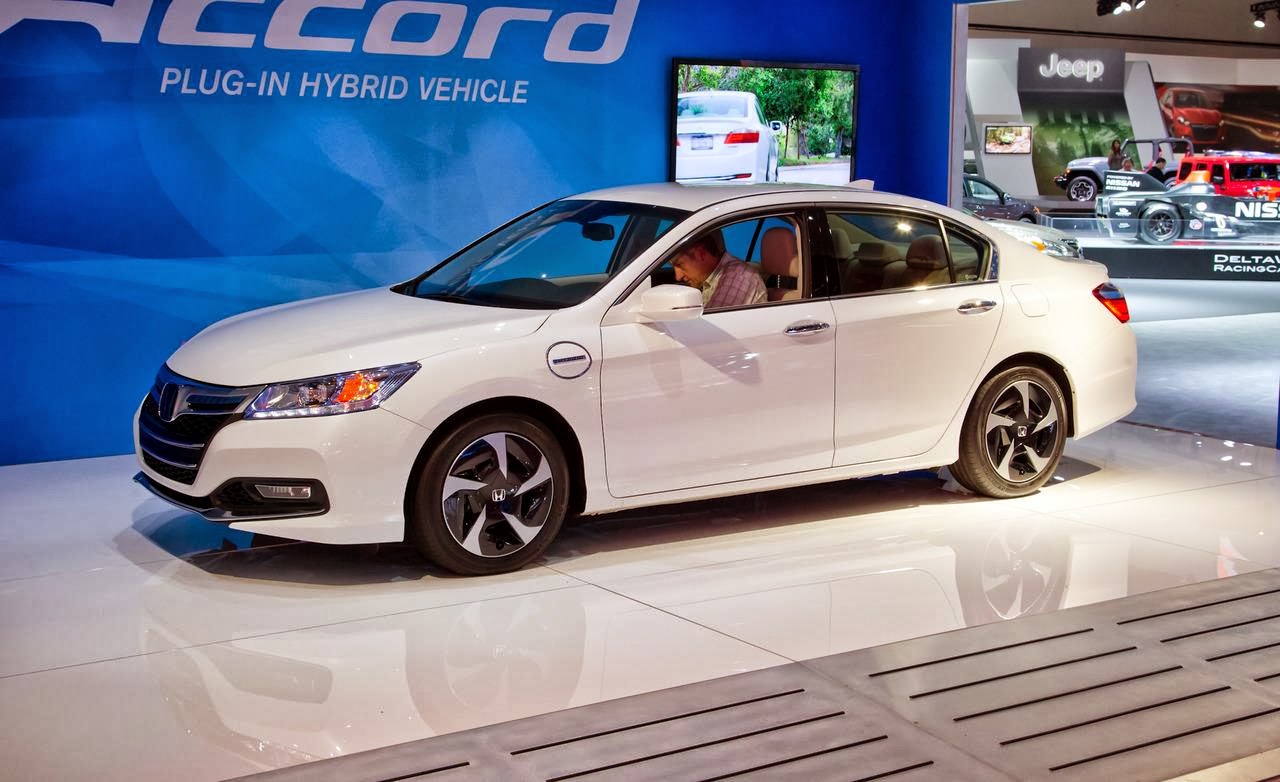
2014 Honda Accord Hybrid Exterior-007
As of October, the most fuel-efficient mid-sized sedan in America is the Honda Accord. Or so Honda says. After all, Ford has been trumpeting a matching 47 MPG combined from their Fusion. Who is right? And more importantly, can the Accord get Honda back into the hybrid game after having lost the initial hybrid battles with their maligned Integrated Motor Assist system? Honda invited us to sample the 2014 Accord Hybrid as well as a smorgasbord of competitive products to find out.


Exterior
I have always been a fan of “elegant and restrained” styling which explains my love for the first generation Lexus LS. That describes the 2014 Accord to a tee. Like the regular Accord, the hybrid is devoid of sharp creases, dramatic swooshes, edgy grilles or anything controversial. This is a slightly different take than the Accord Plug-in which swaps the standard Accord bumper for a bumper with a slightly awkward gaping maw. In fact, the only thing to show that something green this way someday are some grille inserts and  LED headlamps on the top-level Touring model.

This means the Accord and the Mercedes E-Class are about the only sedans left that sport a low beltline and large greenhouse. Opinions on this style decision range from boring to practical and I fall on the latter. I think the Ford Fusion is more attractive but the Hyundai Sonata’s dramatic style hasn’t aged as well as its Kia cousin’s more angular duds. The Camry failed to move my soul when it was new and it hasn’t changed much over the years. This places the Accord tying with the Optima for second place.
2014 Honda Accord Hybrid Interior, Picture Courtesy of Alex L. Dykes
Interior
Despite sporting an all-new interior in 2013, you’d be hard pressed to identify what changed over the last generation Accord unless you owned. Instead of radical design buyers will find incremental improvements and high quality plastics. The dash is still dominated by a double-bump style dashboard with the second binnacle housing a standard 8-inch infotainment display. With manufacturers moving toward slimmer dash designs the Accord’s remains tall and large. For hybrid duty Honda swiped the Plug-in’s tweaked instrument cluster with a large analogue speedometer, no tachometer, LED gauges for battery, fuel and a power meter. Everything else is displayed via a full-color circular LCD set inside the speedometer.

Front seat comfort is excellent in the accord with thickly padded ergonomically designed front seats. There isn’t much bolstering (as you would expect from a family hauler) so larger drivers and passengers shouldn’t have a problem finding a comfortable seating position. The product planners wisely fitted adjustable lumbar support and a 10-way power seats to all trims.
2014 Honda Accord Hybrid Interior, Picture Courtesy of Alex L. Dykes
Speaking of trim levels, in most ways (with the exception of that driver’s seat), the Accord EX serves as the “feature content” base for the hybrid. This means you’ll find dual-zone climate control, tilt/telescoping steering wheel, standard Bluetooth, a backup camera, keyless entry/go and active noise cancellation.

Thanks to a wheelbase stretch in 2013, the Accord hybrid sports 1.3 inches more legroom than the last Accord and is finally class competitive with essentially the same amount of room as the Fusion and Camry and a few inches more than the Koreans. The Accord’s upright profile means getting in and out of those rear seats is easier than the low-roofline competition and it also allows the seating position to be more upright. Honda’s sales pitch about the low beltline is that it improves visibility for kids riding in the back, I’m inclined to believe them. As with most hybrids, there’s a trunk penalty to be paid but thanks to energy dense Lithium-ion cells the Accord only drops 3 cubic feet to 12.7 and I had no problem jamming six 24-inch roller bags in the trunk.  Honda nixed the folding rear seats, a feature that the competition has managed to preserve.
2014_Accord_Hybrid_Touring_043, Picture Courtesy of Honda
Infotainment, Gadgets and Pricing

Base Accords use physical buttons to control the standard 8-inch infotainment system and sport 6 speakers with 160 watts behind them.  Honda wouldn’t comment on the expected model split of the Accord, but I suspect that most shoppers will opt for the mid-level EX-L which adds a subwoofer, 360 watt amp, and adds a touchscreen for audio system controls. The dual-screen design struck me as half-baked when I first sampled it in the regular 2013 Accord and although I have warmed up to it a bit, I think it could still use a few minutes in the oven if you opt for the navigation equipped Touring model.

Honda’s concept was to move all the audio functions to the touchscreen thereby freeing the upper screen for some other use like the trip computer or navigation screen. The trouble is the lower screen simply selects sources and provides track forward/backward buttons meaning you still have to use the upper screen to change playlists or search for tracks. That minor complaint aside, the system is very intuitive and responsive. Honda’s improved iDevice and USB integration is standard fare on all models and easily ties with the best in this segment.
2014_Accord_Hybrid_EX-L_ Picture Courtesy of Honda
Starting at $29,155, the base Accord Hybrid is the most expensive mid-sized hybrid sedan by a decent margin especially when you look at the $25,650 starting price on the Hyundai Sonata Hybrid. However, the Accord Hybrid delivers a high level of standard equipment including standard Pandora smartphone app integration and Honda’s Lane Watch system. Lane watch still strikes me as a little gimmicky since the Accord has such small blind spots and the best outward visibility in the segment already. Instead of stand alone options Honda offers just three trim levels. The next step is the $31,905 EX-L model which adds leather seats, a leather steering wheel, upgraded audio system with two LCD screens, memory driver’s seat, power passenger seat, moonroof, a camera based collision warning system and lane departure warning. While the base model is a little more expensive than cross-shops, the EX-L becomes a decent value compared to comparably equipped competitive hybrids.

Working your way up to the top-of-the-line $34,905 Touring model the Accord is no longer the most expensive in the class, that award goes to the $37,200 loaded fusion. At this price the Accord is less of a bargain compared to the competition, although you do get full LED headlamps and an adaptive cruise control system. In comparison the Camry spans from $26,140 to $32,015, the Sonata from $25,650 to $32,395, Optima from  $25,900 to $31,950 and the Fusion from $27,200 to $37,200. How about the Prius? Glad you asked. The Prius that is most comparable to the base Accord Hybrid is $26,970 and comparably equipped to the Accord Touring is $35,135.
2014 Honda Accord Hybrid Engine, Picture Courtesy of Alex L. Dykes
Drivetrain
Being the drivetrain geek that I am, what’s under the hood of the Accord hybrid is more exciting than the Corvette Stingray. Seriously. Why? Because this car doesn’t have a transmission in the traditional sense. Say what? Let’s start at the beginning. The last time Honda tried selling an Accord hybrid, they jammed a 16 HP motor between a V6 and a 5-speed automatic. The result was 25MPG combined. The 2014 hybrid system shares absolutely nothing with the old system. No parts. No design themes. Nothing.

Things start out with the same 2.0L four-cylinder engine used in the Accord plug-in. The small engine is 10% more efficient than Honda’s “normal” 2.0L engine thanks to a modified Atkinson cycle, an electric water pump, cooled exhaust gas return system, and electric valve timing with a variable cam profile. The engine produces 141 horsepower on its own at 6,200 RPM and, thanks to the fancy valvetrain, 122 lb-ft from 3,500-6,000 RPM.

The engine is connected directly to a motor/generator that is capable of generating approximately 141 horsepower. (Honda won’t release details on certain drivetrain internals so that’s an educated guess.) Next we have a 166 horsepower, 226 lb-ft motor that is connected to the front wheels via a fixed gear ratio. Under 44 miles per hour, this is all you need to know about the system. The 166 horsepower motor powers the car alone, drawing power from either a 1.3 kWh lithium-ion battery pack, or the first motor/generator. Over 44 miles per hour, the system chooses one of two mods depending on what is most efficient at the time. The system can engage a clutch pack to directly connect the two motor/generator units together allowing engine power to flow directly to the wheels via that fixed gear ratio. (Check out the diagram below.)
Front Wheel Drive Biased
Pay careful attention to that. I said fixed gear ratio. When the Accord Hybrid engages the clutch to allow the engine to power the wheels directly (mechanically), power is flowing via a single fixed ratio gear set. The fixed gear improves efficiency at highway speeds, reduces weight vs a multi-speed unit and is the reason the system must use in serial hybrid mode below 44 mph. There is another side effect at play here as well: below 44 MPH, the system’s maximum power output is 166 horsepower. The 196 combined ponies don’t start prancing until that clutch engages.

So why does Honda call it an eCVT? Because that fits on a sales sheet bullet point and the full explanation doesn’t. Also, a serial hybrid can be thought of as a CVT because there is an infinite and non-linear relationship between the engine input and the motor output in the transaxle.
2014 Honda Accord Hybrid Gauges, Picture Courtesy of Alex L. Dykes
Drive
Let’s start off with the most important number first: fuel economy. With a 50/45/47 EPA score (City/Highway/Combined), the Accord essentially ties with the Fusion on paper and, although Honda deliberately avoided this comparison, is only 3MPG away from the Prius-shaped elephant in the room. In the real world however the Accord was more Prius than Fusion, averaging 45-46 mpg in our highway-heavy (and lead-footed) 120 mile route and easily scoring 60-65 mpg in city driving if you drive if like there’s an egg between your foot and the pedal of choice. Those numbers are shockingly close to the standard Prius in our tests (47-48 MPG average) and well ahead of the 40.5 MPG we averaged in the Fusion, 35.6 in the Hyundai/Kia cousins and 40.5 in the Camry. Why isn’t Honda dropping the Prius gauntlet? Your guess is as good as mine.

Due to the design of the hybrid system, I had expected there to be a noticeable engagement of the clutch pack, especially under hard acceleration when the system needs to couple the engine to the drive wheels to deliver all 196 combined ponies. Thankfully, system transitions are easily the smoothest in this segment besting Ford’s buttery smooth Fusion and night and day better than the Camry or Prius. Acceleration does take a slight toll because of the system design with 60 MPH arriving in 7.9 seconds, about a half second slower than the Fusion or Camry but half a second faster than the Optima or Sonata and several hours ahead of the Prius.
2014 Honda Accord Hybrid Exterior, Wheels, Picture Courtesy of Alex L. Dykes
At 69 measured decibels at 50 MPH, the Accord hybrid is one of the quietest mid-sized sedans I have tested scoring just below the Fusion’s hushed cabin. This is something of a revelation for the Accord which had traditionally scored among the loudest at speed. When driving in EV mode (possible at a wide variety of highway speeds) things dropped to 68 db at 50 MPH.

When the road starts winding, the Accord Hybrid handles surprisingly well. Why surprisingly? Well, the hybrid system bumps the curb weight by almost 300 lbs to 3,550 (vs the Accord EX) and swaps in low-rolling resistance tires for better fuel economy. However, unlike the Camry and Korean competition, the Accord retains the 225 width tires in the conversion. This makes the Accord’s fuel economy numbers all the more impressive. The Fusion is 150 lbs heavier and rides on either 225 or 235 (Titanium only) width tires which also explains why the hybrid Fusion Titanium gets worse mileage than the base Hybrid SE model. I wouldn’t call the Accord Hybrid the equal of the gas-only Accord EX on the road, but the difference is smaller than you might think.
2014 Honda Accord Hybrid Exterior, Picture Courtesy of Alex L. Dykes
Helping the Accord out on the road are “amplitude reactive dampers” or “two mode shocks” as some people call them. These fancy struts have worked their way down from the Acura line and use two different valves inside the damper to improve low and high-speed damping performance. The difference is noticeable with the Hybrid having a more compliant ride, and thanks to thicker anti-roll bars the hybrid is more stable in corners. Still, for me, the Accord gives up a hair of performance feel to the Fusion hybrid out on the road. It’s just a hair less precise, not as fast to 60 and lacks the sharp turn-in and bite you get in the Fusion Titanium with its wider and lower profile tires. However, keep in mind that Fusion Titanium takes a 1-2MPG toll on average economy in our tests dropping the Fusion from 40.5 to 38-39 MPG.

The Accord may not be the best looking hybrid on sale, (for me that’s still the Ford Fusion) but the Accord’s simple lines and unexpectedly high fuel economy make the Honda a solid option. Being the gadget hound I am, I think I would still buy the Fusion, but only in the more expensive Titanium trim. If you’re not looking that high up the food chain, the Accord Hybrid is quite simply the best fuel sipping mid-size anything. Prius included.

Honda provided the vehicle, insurance and gas at a launch event.
Specifications as tested
0-30: 3.2 Seconds
0-60: 7.9 Seconds
Cabin noise at 50 MPH: 69 db
Average Observed Fuel Economy: 45.9 MPG over 129 miles.

Source;

Ditching the Transmission Allowed Honda’s Accord Hybrid to Hit 50 MPG

Honda’s Hybrid Accord uses electric motors in lieu of all but one gear. 

by Kevin Bullis of www.technologyreview.com
 
Honda says it has found a way to improve the efficiency of hybrids—and in all likelihood significantly lower the cost to build them. For its new Honda Accord Hybrid, which goes on sale across the U.S. at the end of the month, it’s done away with the car’s transmission.

Hybrids could help automakers meet fuel economy regulations, but their sales are limited by high costs, which are as much as $5,000 more than conventional cars. It may eventually be possible to reduce the price gap to zero, according to a spokesperson from Honda.

Hybrids typically use complex transmissions, or power splitters, to coordinate between the gasoline engine and electric motor that propel hybrids. To get rid of this system, engineers designed the new Accord Hybrid so that most of the time the gas engine isn’t mechanically connected to the wheels. It serves only to spin a generator, which charges a battery. The battery then delivers electricity to a motor that drives the wheels. Electric motors can operate over a wide variety of speeds, eliminating the need to shift gears. To this point, the new design isn’t novel–it’s known as a series hybrid design.

But series hybrids aren’t always as efficient as hybrids that use a transmission. You lose energy when you convert the mechanical energy from the engine into electric energy to charge the battery, and then back into mechanical energy via a motor. (Taking this hit makes sense sometimes, since storing energy in a battery makes it possible to keep the engine operating in its sweet spot, avoiding loads and speeds where it’s very inefficient.) In the early days of talking about the Chevrolet Volt, GM made it sound like it would be a series hybrid. But engineers introduced a complex transmission to allow the gas engine to drive the wheels directly in some situations, improving efficiency by 10 to 15 percent.

Honda found a simpler approach. It uses the electric motor to get the car up to a steady, highway speed. At that point, a clutch allows the gas engine to drive the wheels directly. Basically, the car has only one high gear, and it uses the electric motor in lieu of all the other gears.

Honda says this system is key to allowing the car to get 50 miles per gallon in the city and 45 miles per gallon on the highway, impressive figures for a car its size. In comparison, the non-hybrid version of the Accord gets 26 mpg city and 34 mpg highway, and the similarly sized Toyota Camry Hybrid only gets 43 mpg in the city and 39 on the highway. (The Ford Fusion Hybrid officially comes close, with 47 mpg in both the city and highway, but Consumer Reports found the actual mileage was far lower—just 35 and 41 in city and highway.)

The new approach does have the potential to reduce costs and improve efficiency, says John Heywood, a professor of mechanical engineering at MIT. But he notes that transmissions are also getting very efficient, so every automaker isn’t necessarily going to take this path. He expects the cost difference between hybrids and conventional vehicles to decline to $2,000 by 2030. “Costs will come down, but there’s a lot more stuff in a hybrid, so it’s inevitably going to cost somewhat more,” he says.

Source;
http://www.technologyreview.com/view/520106/ditching-the-transmission-allowed-hondas-accord-hybrid-to-hit-50-mpg/

Tuesday, October 8, 2013

Motoring: Honda Jazz / Fit Type R under development; Turbocharged Mazda3 Speed Hybrid; Subaru WRX Hybrid

Subaru planning WRX Hybrid as Honda Jazz Hybrid Type R and turbocharged Mazda3 Hybrid also take shape
 
News of Nissan’s giant-killing GT-R going hybrid in its next generation raised plenty of eyebrows among sports car fans recently, but the electrified supercar is not the only Japanese performance hybrid in the works.

The Toyota Prius put hybrid cars on the map way back in 1997 and Japan’s biggest car-maker has launched more than a dozen petrol-electric vehicles since then.

Indeed, widespread deployment of hybrid drive technology is what most manufacturers are now undertaking to meet the more stringent emissions regulations and fuel consumption expectations of the motoring public, spelling hybrid power for everything from smallest hatches to the mightiest supercars.

In fact, as demonstrated by the Porsche 918 Spyder and LaFerrari hyper-hybrids, the only way to produce ever more powerful performance models that deliver acceptable emissions levels is to hybridise them.

Now, with hybrids getting known not just for their fuel-saving abilities but also their performance-enhancing traits, Japanese car-makers Honda, Mazda and Subaru are getting in on the hybrid act with high-performance models in the pipeline, as these renderings from Japan’s Best Car magazine suggest.

The first kid on Japan’s high performance hybrid block will be Honda’s Jazz Hybrid Type R.

Motoring.com.au understands Honda engineers are currently finalising details for a hybrid version of the new Jazz that would boost total power to an impressive 140kW (up from 80kW in the standard 1.5-litre Jazz RS model upon which it’s based) while returning fuel consumption of 3.6L/100km.

Honda’s first hybrid Type R will be fitted with the same seven-speed dual-clutch automatic transmission (DCT) seen in the upcoming Jazz Hybrid and will employ specially tuned suspension.

Slated for a 2015 debut, the Jazz Type R should start at around $25,000 – just a few thousand dollars more than the existing Jazz Hybrid.

Mazda will also enter the hybrid fray with its Mazda3 Hybrid. Based on the new-generation Mazda3 due here in a few months &, the electrified Mazda3 will combine a Toyota-sourced hybrid system from the Prius with a turbocharged 2.0-litre petrol engine to deliver total power output of around 221kW (300hp) and 392Nm of torque.

While that should be enough for the Mazda3 Hybrid to wear an MPS badge, fuel economy will remain at a frugal 5.0L/100km. However, Mazda has so far committed to releasing its first hybrid model by the end of this year only in Japan, where it should be priced around the Australian equivalent of about $30,000.

Meantime at Subaru, the new WRX line-up due here in March following its LA motor show debut next month will be crowned by the 220kW-plus WRX STI due in late 2014, but Subaru has something else on the table -- a WRX Hybrid.

As we’ve seen with the BRZ and Toyota 86 joint-venture sports cars, Subaru has a strong relationship with Toyota and has no doubt borrowed some hybrid technology from its sizeable partner. But the hybrid system Subaru will use for its ground-breaking WRX Hybrid comes straight from its big-selling (in Japan) XV Hybrid, which was developed in-house after over a decade of research in the Tochigi R&D centre.

To be initially fitted to the WRX and later to the Liberty, Subaru’s 2.0-litre boxer-powered hybrid system will also employ a turbocharger to generate total power of more than 220kW and 387Nm of torque.

This is a combination that Subaru fans worldwide have been waiting for; loads of performance (in this case from a powerful turbo-petrol and electric drivetrain) that also delivers fuel consumption of around 5.5L/100km -- something that has eluded boxer engines up until now.

And that’s just the tip of the iceberg. Expect more performance hybrids, combining the torque of turbo-petrol engines and electric motors, from other Japanese manufacturers like Toyota and Nissan in the near future.

Source;
http://www.motoring.com.au/news/2013/performance-hybrids-gather-pace-39261

2015 Subaru WRX caught on camera almost undisguised?

A Japanese video has surfaced that shows what appears to be a prototype for the 2015 Subaru WRX. The video was made earlier this year and was primarily created to showcase Subaru's new EyeSight driving assistance technology.

We first saw the model at the New York Auto Show in March when Subaru unveiled the stunning WRX Concept. In the months that followed, numerous prototypes have been spotted and close comparison leads us to believe the model above is a virtually undisguised prototype we are pining to see.

The front end has striking similarities to the concept and prototypes already seen including the huge air intake built into the hood. The low quality of the video makes it a little more difficult to confidently identify the model, but it doesn't hurt to add a little speculation.

Check it out below just after the six minute mark and see for yourself.

Source (via www.carscoops.com)
http://www.worldcarfans.com/113100763984/2015-subaru-wrx-caught-on-camera-almost-undisguised

Honda Plots U.S. Hybrid Resurgence Starting With Accord

Honda Motor Co. (7267), first to sell hybrids in the U.S., plans a gasoline-electric lineup overhaul starting with an Accord Hybrid it says tops Toyota Motor Corp. (7203) and Ford Motor Co. sedans as it seeks relevancy in the segment.

The 2014 version of Tokyo-based Honda’s flagship sedan goes on sale Oct. 31, with a base price comparable with a V-6 engine version of the Accord, and that’s rated as getting 50 miles (80 kilometers) per gallon in city driving. That’s just the start, said John Mendel, executive vice president of the U.S. unit.

Honda needs better-selling hybrids. Current models, including the Insight hatchback, CR-Z coupe and a version of the Civic, generate a fraction of Prius deliveries. Honda’s Insight beat the Toyota hybrid to the U.S. by about six months. Yet the company that led U.S. fuel economy ranking for years stumbled in designing a compelling challenger to Prius.

“Accord is a great place for us to stop the science experiments and really make a name for our hybrids,” Mendel said in an interview in San Antonio last week. “We’re known for fuel economy, but in hybrids, it’s about relevance and volume. We think Accord can do that.”

The Accord Hybrid’s label rating, a combined 47 mpg in city and highway driving based on U.S. government tests, ranks it behind only Prius, a mid-size car that averages 51 mpg in the city, 48 mpg on the highway and 50 mpg combined, the best of any non-rechargeable vehicle in the U.S.

While Ford (F)’s Fusion hybrid is also rated 47 mpg combined, Ford faces lawsuits claiming the car’s mileage is overstated. Toyota’s hybrid Camry averages a combined 41 mpg.

Prius’ Shadow

Toyota expects to sell 250,000 Prius models this year. By comparison, Honda’s current hybrid line is on a pace to sell about 19,000 vehicles this year.

Combined sales of hybrids, plug-in hybrids and battery-only autos are headed for a record this year. Through September U.S. car buyers bought about 450,000 such vehicles, based on data compiled by Bloomberg, up 28 percent from about 352,000 a year earlier. Last year was a record for electric-drive vehicles, with sales of about 475,000 cars and light trucks.

Honda anticipates sales of Accord Hybrid, priced from $29,155 to $34,905, will fall in the “2,500 to 4,000” units per month range of Ford’s Fusion Hybrid and the Toyota Camry Hybrid, Mendel said.

The Accord Hybrid’s new two-motor powertrain has components adapted from Honda’s futuristic FCX Clarity hydrogen fuel-cell sedan and battery-electric Fit EV, Hiroo Shimada, the chief engineer who oversaw development of the Accord system, said in an interview.

Accord Sales

The Accord is the second-best-selling mid-size sedan in the U.S. this year, with 282,102 deliveries, behind Camry’s 318,990. The pattern has changed little for more than a decade.

Following the Accord, the company this year also releases a three-motor, all-wheel drive “sport hybrid” version of the premium Acura RLX sedan. A variation of its so-called SH-AWD powertrain will also be used in the 2015 NSX supercar Honda plans to build in Ohio, the company said.

For lower-priced small vehicles, Honda has a new single-motor, dual clutch powertrain that’s being used first on a version of the new Fit subcompact that’s gone on sale in Japan.

There’s no plan to sell Fit hybrids in the U.S. Still, the car’s gasoline-electric system may appear on other models, Mendel said.

“It’s a surprisingly fuel-efficient system,” he said.

New Models

New Honda and Acura hybrids are in the works, in part to help the company comply with the U.S. government’s push to double the average fuel efficiency of new vehicles by 2025, as well as to address volatile fuel prices, Mendel said. The company also wants to burnish its reputation as an industry leader in fuel economy and advanced technology, he said.

Accord Hybrid “can be a great entry point to establish our manufacturing prowess and development expertise in the hybrid area,” Mendel said. “Fifty miles a gallon is going to cut through.”

Honda’s American depositary receipts fell 1.2 percent to $37.91 at the close yesterday in New York. They have gained 2.6 percent this year, compared with a 14 percent advance in the benchmark NYSE Composite Index.

Source;
http://www.bloomberg.com/news/print/2013-10-07/honda-plots-u-s-hybrid-resurgence-starting-with-accord.html

Monday, October 7, 2013

Honda working on a new hatchback to compete with Maruti Suzuki Alto 800

The performance of the Amaze compact sedan has completely changed the image of Honda in the Indian car market. Sometime ago, the Japanese car maker was labelled as a brand that does not produce vehicles for the masses. However, as a part of the brand redevelopment program, the firm worked on the i-DTEC technology, which has turned out to be a huge success. The Amaze has managed to eat in on the sales of the Maruti Suzuki Swift DZire, which indicates the kind of impact it has made in India. Now, banking on the success of this model, the company has planned aggressively for the Indian car market in the coming years. According to sources, the firm is going to launch the diesel version of Honda City in the year 2014. Now, fresh reports have surfaced regarding the production of an entry-level hatchback, which is likely to take place at a new plant.

Although nothing has been confirmed by the auto maker, rumours and speculations indicate that Honda is planning to build on the good work done in the recent past. Reports claim that top officials from the firm held a meeting to discuss and contemplate the way forward in context of the Indian car market. After rivalling Maruti Suzuki directly in the compact sedan segment, the Japanese auto maker wants to compete with an entry-level hatchback. To facilitate the same, the company, sources suggest, has started a comprehensive research on the new production facility and is considering a number of locations.

Industry experts feel that Honda has the potential to perform well in the entry-level hatchback segment despite strong competition. At present, this segment is being led by the likes of Maruti Suzuki Alto 800 and Hyundai Eon, which have done exceptionally well. The Japanese auto maker, currently, sells the Brio hatchback in the Indian market, a car that has got excellent reviews from experts. The hatchback segment has tremendous potential in India, which means that Honda can do wonders regardless of the number of competitors it has in the country.

Sources suggest that even the company is looking forward in the same direction and increase its market share in India. An official from Honda, close to this campaign, said, "We have to run fast to get volumes in India because we are very small today. Honda feels that to maintain and grow its global market share by 2020, increased capacity will be needed in emerging markets like India, from where the growth will actually come, since developed markets are near saturation. Talks are on for various products, but nothing has been frozen. But only when we are sure of utilising the new capacity at Tapukara, can we ask the headquarters for more investment."

Source;

Honda designer talks about Next Sportscar

TOKYO -- Honda Motor Co., aiming to re-energize its performance cred, is studying a revival of an S2000-type sporty car.

The automaker's top exterior designer says he wants a midlevel sporty car added to the lineup between the two sports cars under development. A revived Acura NSX will debut atop the automaker's lineup in 2015. And at the bottom, Honda is targeting Japan with a sporty minicar inspired by the Small Sports EV Concept shown at the 2011 Tokyo Motor Show.

"We are making the NSX and the small sporty minicar," Toshinobu Minami said in a recent interview at Honda's global design center. "Naturally, I personally want something in between."

Although his comments represented his own ambitions, such an entry was under study, he said. He declined to give details.

To properly nurture sports-car nameplates, a company must keep making them, Minami said, criticizing Honda's decision to drop sports cars when the global financial crisis hit.

"Don't quit," said Minami, who oversees global exterior design for the Acura and Honda brands. "Quitting the NSX and the S2000 is the thing I regret most."

Honda dropped the NSX in 2005 and scrubbed plans to revive it in 2008, as the foundering global economy undercut earnings. The company said at the time it needed more practical offerings. In January 2009, it said it was killing the S2000 roadster, a jaunty rear-wheel-drive, four-cylinder convertible, after a 10-year run.

Each car had a loyal following.

It is important to keep selling sporty cars "no matter what condition the company is in," Minami said. "It maintains that relationship with the customer."

He said the Honda brand's current sporty offering, the hybrid CR-Z compact hatchback, fills an important niche because of its electrified drivetrain. But the lineup also needs a more traditional driver's car, he said.

"I want to keep hybrid sports cars like the CR-Z," Minami said. "I also want to do something like the original S2000 we used to have. I want to do both."

Rediscovering Honda's roots is a top priority, he said.

"We have lost a bit of our sportiness while retaining good functionality," Minami said. "First, we want sportiness. The thing I want most is to recover our uniqueness."


Source;
http://www.autonews.com/article/20131007/OEM03/310079963/honda-designer-wants-sporty-car#axzz2h2kxNbFD

Honda/Acura NSX Concept GT Japanese Commercial